Directed by: Carol Reed
Written by: Walter Ebert (story), Harry Kurnitz (screenplay), Eric Linklater (screenplay) (uncredited)
Starring: James Mason, Claire Bloom, Hildegard Knef, Geoffrey Toone, Aribert Wäscher, Ernst Schröder, Karl John
WARNING: Plot and/or ending details may follow!!! [Paragraph 3 only]
Following the release of his masterpiece The Third Man (1949), a refreshingly-offbeat amalgam of British noir and Ealing-style whimsy, director Carol Reed was heralded as one of the era's most promising filmmakers. Critical admirers anxiously awaited his follow-up effort, which was four years coming. Today, the consensus appears to regard The Man Between (1953) as little but a pale imitation of The Third Man. Certainly, the two films share similar scenarios, both involving a foreigner's espionage-tinged visit to a war-torn city (Vienna and Berlin, respectively) that has been divided by opposing powers. However, despite lacking Graham Greene's wry sense of humour, and particularly the boyish charisma of Orson Welles, Reed's follow-up picture is nonetheless an excellent drama, blending romance and tragedy with the director's usual flair for generating atmosphere and international intrigue. The fine chemistry between stars James Mason and Claire Bloom finds a life of its own amid the rubble-strewn ruins of a city still at war with itself.
 Young British woman Susanne Mallison (Claire Bloom, whom Chaplin had discovered the previous year for Limelight (1952)) arrives in Berlin to visit her brother (Geoffrey Toone), who has married German-born Bettina (Hildegard Knef). Through her sister-in-law, Susanne is introduced to the enigmatic Ivo Kern (James Mason), a professional kidnapper with ambiguous allegiances towards both the Eastern and Western powers. Screenwriter Harry Kurnitz had a talent for illustrating characters with hidden motives and concealed secrets (see Witness for the Prosecution (1957), The Web (1947) or either of his Thin Man features), and his screenplay spends its first half ominously exploring the intentions of Bettina, whose association with Ivo implicitly suggests a family betrayal. Interestingly, the character is effectively abandoned in the film's second half, but to the film's advantage, as Susanne and Ivo are relentlessly hunted in the Eastern Bloc following a botched kidnapping. Here, Reed narrows his dramatic focus, but the doomed romance between Bloom's young idealist and Mason's war-weary criminal remains appropriately understated, inspiring empathy without stooping to melodrama.
 Despite the absence of Robert Krasker, The Man Between is a beautifully shot film, with director-of-photography Desmond Dickinson capturing, not only the atmosphere, but the foreboding personality of the crumbling German capital. John Addison's musical score is haunting and graceful, certainly a far cry from Anton Karas' zither, but nonetheless effective in its own right. One thing I've noticed about every Carol Reed film I've seen (and the tally currently sits at seven) is that all the performances are perfect – not only the main and supporting stars, but everybody down to the briefest of speaking roles. James Mason sports a convincing German accent, and Claire Bloom is simply adorable in her naive innocence, with a smile that will melt your heart. A particularly important character is young Horst (Dieter Krause), whose love Ivo instinctively rejects, for such a criminal can never allow himself to form attachments to those he must inevitably abandon. Ultimately, and tragically, it is Horst's devotion that results in Ivo's death, the final proof that love and death are never far apart.
8/10
Currently my #7 film of 1953:
1) From Here To Eternity (Fred Zinnemann)
2) Stalag 17 (Billy Wilder)
3) I Confess (Alfred Hitchcock) *
4) The Titfield Thunderbolt (Charles Crichton)
5) Le salaire de la peur {The Wages of Fear} (Henri-Georges Clouzot)
6) Roman Holiday (William Wyler)
7) The Man Between (Carol Reed) *
8) The Band Wagon (Vincente Minnelli)
9) Pickup on South Street (Samuel Fuller) *
10) The War Of The Worlds (Byron Haskin)
2) Stalag 17 (Billy Wilder)
3) I Confess (Alfred Hitchcock) *
4) The Titfield Thunderbolt (Charles Crichton)
5) Le salaire de la peur {The Wages of Fear} (Henri-Georges Clouzot)
6) Roman Holiday (William Wyler)
7) The Man Between (Carol Reed) *
8) The Band Wagon (Vincente Minnelli)
9) Pickup on South Street (Samuel Fuller) *
10) The War Of The Worlds (Byron Haskin)

 The Killers opens with a superbly-thrilling prologue that sees two hired thugs (William Conrad and B-noir stalwart Charles McGraw) harass the patrons at a small-town diner on their way to assassinate boxer- turned-gangster Swede Andersen. The characters' quickfire exchange of dialogue resembles something that Quentin Tarantino or the Coen brothers would have written decades later, only better, because screenwriter Anthony Veiller (with Richard Brooks and John Huston) reproduces the conversation from Hemingway's short story almost verbatim. After Andersen is unresistingly gunned down in his bed, the screenplay then expands upon the foundations laid down by the source material, using flashbacks to fill in the empty spaces at which Hemingway had only hinted. Veiller, whose work before WWII was dominated by romantic dramas, comedies and light mysteries like The Ex-Mrs. Bradford (1936), appears to have been hardened by his work on Frank Capra's Why We Fight propaganda series, and the dark, cynical post-War tone he brings to Swede's tragic story is an ideal representation of the noir spirit.
  Burt Lancaster shows promise in his screen debut, though the film's narrative structure does keep the audience distant from his character, an issue that Welles somehow avoided in Citizen Kane. As the resident femme fatale, Ava Gardner never quite inspires the collective hatred garnered by Barbara Stanwyck in Double Indemnity (1944) or Jane Greer in Out of the Past (1947), but perhaps that speaks to her charms – that, despite her betrayal, we're still unwilling to treat her with due contempt. Good-guy Edmond O'Brien cheerfully and voyeuristically experiences the wretched life of a gangster through the intermediary flashback device – he ends the film with a cocky grin, like an audience-member emerging from a screening of the latest gangster thriller. Throughout this review, I've been making frequent allusions to Citizen Kane, but there's a very important difference between the two main characters: Charles Foster Kane had all the money in the world and got nothing out of it. Swede Andersen wasn't even that lucky; he didn't even get the money.
  WARNING: Plot and/or ending details may follow!!! [Paragraph 3 Only]
 Robert Wise was certainly one of Hollywood's most versatile directors, having released excellent films from almost every major genre – science-fiction, horror, drama, musical, war. The Set-Up was produced on a low budget by RKO, with a story that unfolds in real-time (predating Zinnemann's High Noon (1952), which famously used this approach). Despite a taut 72-minute running-time, the film packs a considerable emotional punch, as the sympathetic Stoker places his dignity on the line, sticks to his guns, and winds up being punished for his nobility. Robert Ryan gives a characteristically intense leading performance, eliciting empathy, but also exhibiting a quiet, understated dignity. When his fellow boxers emerge from their bouts, either ecstatic in victory or discouraged in defeat, there's a heartbreaking sadness in Stoker's eyes, as though every time he must front the challenge of his own aging body. Among the compelling supporting performers is David Clarke as a self-deluding washed-up boxer, and Alan Baxter (looking a bit like Frank Sinatra, I thought) as a cold-eyed gangster who wears sharp suits but, unlike Stoker, hasn't any class or principles.
 The Set-Up, in exposing the unglamorous side of the boxing profession, certainly served as inspiration for Martin Scorsese's Raging Bull (1980), and probably also influenced Kubrick in his early noir thriller Killer's Kiss (1955). The boxing match between Stoker and Tiger Nelson (Hal Fieberling) is an gritty four-round exchange of bludgeoning blows, and every connecting swipe sent a shudder of discomfort through my body. Even more fascinating, however, is how Wise focuses much attention on the match spectators, perhaps the most depraved selection of sadistic souls you're likely to find at any sporting event: an excited house-wife calls for a prolonging of the boxers' suffering; a blind man cries "go for his eyes," his cruel mind filling in the bloody details; the ever-composed Little Boy (Baxter) watches through shrewd, calculating eyes. The atmosphere of the boxing stadium is oppressive and stifling, the meeting-place of society's most decadent citizens. Ironically, it is only when he is defeated by this environment that Stoker can ever escape its clutches. He strikes the bottom of the barrel, his honour intact only in his eyes.
 Where the Sidewalk Ends was the only film to reunite Dana Andrews, Gene Tierney and director Otto Preminger after the superb
  The tension, as Dixon attempts to cover up his crime, is absolutely riveting – certainly among the most suspenseful sequences of its era – though I feel that the situation still wasn't exploited to its full potential. The taxi driver is the only person who could have decisively identified Dixon as the perpetrator, but Preminger hurriedly skims over the moment when he passes Dixon on the stairs. Had the witness been brought in as Dixon was re-enacting his own movements outside the apartment entrance, we could have had some genuine fireworks. And why, for that matter, couldn't the taxi driver's testimony have immediately absolved Jiggs Taylor (Tom Tully) from suspicion of murder? Niggling inconsistencies such as these tarnish an otherwise excellent screenplay from Ben Hecht, who infuses his gritty criminal underworld with hard-hitting cops and wise-cracking felons. Andrews' seething and implosive law-enforcer, tormented by rage and remorse, has rarely been done better, at least the equal of Robert Ryan in Nicholas Ray's On Dangerous Ground (1952).
 In my younger years, I found Wolfgang Petersen's Outbreak (1995) to be among the most horrifying movies I'd ever seen. That thriller, which owes plenty to Panic in the Streets {working title: "Outbreak"}, terrified me so efficiently because it depicted the ebola virus as both an invisible and invincible killer – how does one defend themselves against such a thing? Kazan's film is the first (that I know of) to approach the subject of biological epidemics, though it has difficulty ascribing visual recognition to an enemy that is basically undetectable to the human eye; it instead uses Jack Palance as a human personification of the Plague. Despite his venturing out among the filthy dregs of human society, you never get the sense that Clinton Reed is placing his own life at risk {some viewers have noted that Reed never inoculated himself against the plague, though I think it's safe to assume that he did so at the same time as the morgue staff}. Nevertheless, there's still a strong sense of urgency in the hunt for the infected man's killers, underground street-rats who pollute the sewers with their misdeeds.
 In medieval times, when the Black Death (now widely believed to have been bubonic plague) swept across the civilised world, killing a third of Europe's population, many identified the destruction as being the work of the Devil. Jack Palance's character, Blackie, serves effectively as Satan in human form: the angular-jawed thug can occasionally be charming and charismatic, but is always liable to explode into fits of violence; his two hoodlums (played by Guy Thomajan and Zero Mostel), through terror more than anything else, are constantly grovelling at his feet. When one lackey falls ill with fever, Blackie deduces that the man's immigrant cousin must have "brought something in with him" (the irony of his conclusion not passing unnoticed), and so attempts to ascertain what this presumably valuable object must be. He cradles the dying Poldi in his arms, a grotesque display of faux affection that is both pathetic and unsettling. Blackie/Satan is finally stopped – not by the authorities, but by the burden of his own infection/evil – as he attempts to board a cargo ship, the primary vessel by which the Plague spread across Europe.
 Of course, Ladd is joined in the film by his previous co-stars from
  I suppose that film noir, at its heart, is all about fate, and how it never works in our favour. If something can go wrong, it will. Audiences have always been willing to suspend disbelief on such unlikely coincidences, but I think that here Chandler bites off more than he could chew. Not only does Bendix unknowingly go off with Ladd's adulterous wife (an acceptable enough twist of chance), but, of all the rain-soaked people that Lake might have picked up off the side of the road, it happens to be the very person whose soon-to-be-deceased wife was having an affair with her husband. Had the pair met outside, say, Harwood's night-club, this happenstance might have been easier to digest, but, as it stands, the absurd coincidence only distracts from the storyline. No matter – the story itself is filled with unlikable characters and dubious motives, and with gunfire and murder in great abundance. Getting beaten up was always something that Ladd could accomplish most convincingly, and his frantic tussle with two armed gangsters is the highlight of the film.
 Philip Raven (Ladd) is afforded the introduction of a classic hard-boiled anti-hero. After waking up to lovingly greet a stray cat with fresh milk, he then rips open the dress of the landlady's daughter, who tries to disrupt the cat's breakfast, before reprimanding her with a taut slap across the side of the face. Raven is not presented to us as a hero, but neither as a villain; like all good film noir protagonists, his personality and motivations are tantalisingly ambiguous, and so our sympathies towards him are confused. Blonde bombshell Veronica Lake arrives on the scene with a lively performance of "Now You See It, Now You Don't" (her singing voice dubbed by Martha Mears) that is sure to have any male viewers quickly sitting upright. In this film, Lake has none of the frail passiveness that of her follow-up Ladd collaboration
  Alan Ladd here also benefits from the absence of a love interest. One of the few weaknesses of The Glass Key was the unintentionally awkward romantic sequences between Lake and himself. Ladd can surely play hard-boiled, but he doesn't do tender very well (unless the object of his affection is feline). In 'This Gun for Hire,' his relationship with Lake is first one of necessity, but gradually transforms into a mutual respect, and an understanding that hints just enough at sexual attraction without drawing attention to it. Robert Preston is adequate, though oddly insubstantial as the film's most reputable character, and Laird Cregar is interesting as the plump and cowardly villain who's inadvertently bitten off more than he can chew. The film winds down in its final twenty minutes or so, and the finale's weak attempt at patriotism – an apparent obligation under the current political climate – serves to distance the modern viewer from the engrossing and intimate thriller we had previously enjoyed. Nevertheless, if you see it on the rental shelf, this gun is very much worth hiring out.
 The film's plot, of an honest cop trying to bring down a titan of organised crime, is not unique; the most readily-recalled example would be Brian DePalma's The Untouchables (1987), but precursors certainly exist. Lt. Leonard Diamond (Cornel Wilde) is such an honest cop, almost obsessive in his bid to bring down Mr. Brown, though his fanaticism could just as easily be explained by his lust for the crime boss' abused girlfriend, Susan Lowell (Jean Wallace). Diamond is supposed to be the film's driving-force, but he's too dogmatic to make an interesting hero. Unlike the countless flawed anti-heroes who have made so many film noirs memorable – take Marlowe, or Spade, or Hammer, for instance – Diamond's only flaw appears to be that he's a workaholic. Mr. Brown contemptuously describes the detective as "righteous," the word spoken with such derision that he might as well have spit on him. Indeed, so lowly is his opinion of law enforcement that Mr. Brown stubbornly refuses even to address Diamond directly, sardonically issuing threats in the third-person.
 I suppose it wouldn't be entirely accurate to describe Diamond as being a complete saint. After all, we must consider his part-time girlfriend Rita (Helene Stanton), whom he treats like a "pair of gloves," offering his affection only when his life seems particularly hopeless. Ultimately, Rita is assassinated in a case of mistaken identity, and her death gives the detective added incentive to bring down Mr. Brown. This character subplot is obviously an attempt to make Diamond appear more of an anti-hero, but it's a thin attempt, and Wilde's character is best viewed as an obligatory vehicle of moral and legal justice. It is the strong performances of Conte and Brian Donlevy (as Mr. Brown's resentful second-in-command) that really make the film, in addition to the imaginative visuals. Cinematographer John Alton here constructs some of film noir's most iconic images, including the fog-swept airport finale that deliberately diverts the ending of Casablanca (1942) into darker territory. The inspired stylistic decision to show Joe McClure's death without audio also inspired Sam Mendes' rainy shoot-out in Road to Perdition (2002).
 There are three women in this story. Greta (Rita Johnson) is Ballentine's husband, an upright and charismatic businesswoman from a wealthy family, who knows both how her husband operates, and how she can control him with the promise of money. Verna Carlson (Susan Hayward), Ballentine's mistress, is a slick and crafty money-grabber. The couple, at least initially, have no delusions about their relationship: Verna is in it for his money, and he's in it for the sex (this theme, owing to the Production Code, is dealt with tastefully). Hayward plays the role to feisty perfection, and such was her cloaked malevolence that I half-expected her to crop up at the film's end, having somehow faked her own death, stolen Ballentine's money and skipped off to South America. Janice Bell (Jane Greer) is the polar converse of Hayward's femme fatale, perhaps the closest thing to love in Ballentine's life – their relationship, characterised by a mutual love of boating, apparently, seems genuinely platonic, a mutual understanding that our male hero promptly severs with his unquenchable thirst for wealth.
 I was surprised, given its relative obscurity nowadays, at just how strong a film They Won't Believe Me turned out to be. The main and supporting characters are played flawlessly, their traits and motivations explored with more than sufficient depth to justify their later actions, though one still wonders if Verna's apparent sincerity prior to the road accident is, indeed, genuine. As he recounts his tale to the murder jury, Ballentine frequently makes fatalistic allusions towards the inescapably of Fate – here personified in a crippled palomino horse. By the time he's finished telling his incredible story, which may or may not be true {Hitchcock pulled this false-flashback trick several years later, though I won't reveal the details}, we're left with a very raw taste in our mouths. We can sympathise to an extent with Ballentine's extraordinary run of bad luck, but much of his behaviour, even if one excludes the accusation of murder, is so utterly contemptible that he doesn't deserve to live. Yet, from the moment Ballentine catches a bullet in the back, we already know what the jury's verdict had been.
 The chemistry between Bogart and Bacall doesn't quite sizzle here as it usually does, and that our hero spends much of his time behind the camera certainly doesn't help. The film is strongest when it spends time with its supporting characters, which makes me think that Dark Passage might have been a better film had it been cast with relative unknowns. Daves obviously produced the film with one eye on his prized romantic couple, and the accompanying marketing opportunities, and, consequently, the story often tries too hard to create a memorable romance. Though the plot begins to meander towards the predictable in its final reel, the opening acts prove especially engrossing, not only because of the intriguing camera gimmick, but because we absolutely have no idea where this unusual story, with its cast of incredibly offbeat characters, is trying to lead us. It's also rewarding to try and guess how long Jack Warner could tolerate not seeing Humphrey Bogart's face until he threatened to shoot somebody; I think we can safely estimate this figure to sit just beyond one hour.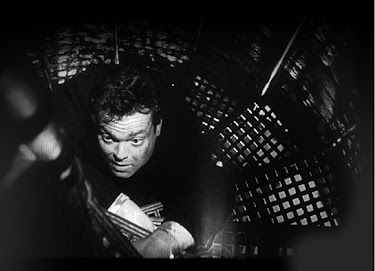


_poster.jpg)


