Showing posts with label Otto Preminger. Show all posts

Saturday, December 26, 2009

Target #66: Fallen Angel (1945, Otto Preminger)

Directed by: Otto Preminger
Written by: Marty Holland (novel), Harry Kleiner (writing)
Starring: Dana Andrews, Alice Faye, Linda Darnell, Charles Bickford, Anne Revere, John Carradine

WARNING: Plot and/or ending details may follow!!!

With Laura (1944) and Where the Sidewalk Ends (1950), director Otto Preminger and actor Dana Andrews collaborated to produce two of the great American film noirs. Fallen Angel (1945) also features this winning combination, but unfortunately lacks something more crucial: conviction. Eric Stanton (Andrews) is the perfect noir anti-hero, an unabashed shyster with a knack for opportunism. After stranding himself in a small American town with a dollar in his pocket, Stanton falls for Stella (Linda Darnell), a vivacious young waitress who'll "befriend" any man who can offer her financial security. Stanton claims that he wants to marry Stella, but he's obviously driven by lust, and his hunger leads him to seek money through dubious means – in this case, by wooing and marrying the spinsterish June (Alice Faye). Where Preminger fumbles is in his unwillingness to punish Stanton. Instead, the irresponsibly- flirtatious Stella is murdered, and our hero's innocence – never really doubted by the audience – distracts from the character's own moral crimes.


The film, at least, is thick with atmosphere. The small-town setting creates a distinct sense of claustrophobia, as though one can't run far enough to escape the watchful eyes of the local residents. Dana Andrews, as always, is excellent in the lead role. Linda Darnell exudes a trashy but undeniably voluptuous sensuality; she's a more openly sexual character than Gene Tierney's Laura, and perhaps more along the lines of Tierney in The Shanghai Gesture (1941) or Jean Peters in Pickup on South Street (1953). The characters played by Alice Faye and Anne Revere are underdeveloped and mostly uninteresting; their innocent, righteous personalities feel as though they should have no place in the film noir style. Charles Bickford, however, is very entertaining as a cocky and sadistic retired detective charged with solving Stella's murder. For the sizzling chemistry of Andrews and Darnell, Fallen Angel is a worthy enough noir thriller, but the director and star have done better, both together and with others.
6.5/10

Currently my #10 film of 1945:
1) The Lost Weekend (Billy Wilder) *
2) Spellbound (Alfred Hitchcock) *
3) Brief Encounter (David Lean)
4) 'I Know Where I'm Going!' (Michael Powell, Emeric Pressburger)
5) Perfect Strangers (Alexander Korda)
6) Leave Her to Heaven (John M. Stahl) *
7) Scarlet Street (Fritz Lang) *
8) And Then There Were None (René Clair)
9) Roma, città aperta {Rome, Open City} (Roberto Rossellini)
10) Fallen Angel (Otto Preminger) *

Read More...

Monday, January 19, 2009

Target #46: Whirlpool (1949, Otto Preminger)

Directed by: Otto Preminger

Written by: Guy Endore (novel), Ben Hecht (screenplay), Andrew Solt (screenplay)

WARNING: Plot and/or ending details may follow!!!

The second of three films that Otto Preminger directed with Gene Tierney, Whirlpool (1949) is also the least of them. Clouded by the dubious Freudian psychology that was sweeping Hollywood in the late 1940s, the film is simply too implausible to prove sufficiently effective, despite the best efforts of the director and stars. I was reasonably willing to accept that David Korvo (José Ferrer) could control Ann Sutton's (Tierney) movements through hypnosis – and, indeed, a similar idea forms the backbone of Frankenheimer's classic thriller, The Manchurian Candidate (1962). However, that the shifty psychologist could hypnotise himself into carrying out murder only hours after voluntarily offering himself for gall-bladder surgery really pushes one's credulity, inspiring laughter rather than intrigue. Perhaps somebody should have told the actors not to take the story quite so seriously, and the resultant lighter mood would have provided some surefire entertainment. As it happens, the principle members all give solid dramatic performances that they probably needn't have bothered with.Gene Tierney was, of course, one of the most stunning actresses to grace the silver screen, but she was also among the most misused. When utilised as a traditional, innocent damsel-in-distress, Tierney's acting is usually dependable without being particularly memorable. However, at least two directors realised that she was at her best when her character's intentions are either ambiguous {see Laura (1944)} or downright evil {see Leave Her to Heaven (1945)}. Given that Preminger directed the first of these, one wonders why he here decided to use Tierney in a purely conventional capacity; he repeated this offence in his follow-up picture, Where the Sidewalk Ends (1950). José Ferrer is smarmily sinister as the psychiatrist abusing his "powers," though the screenplay does him a disservice in the final act. Richard Conte is more subdued than he is in The Big Combo (1955), but nonetheless brings a likable intensity to an otherwise-passive role. Charles Bickford, whom I last saw in Renoir's The Woman on the Beach (1947) here also gives a strong performance.

Whirlpool is strongest in its middle-act, with Tierney as a wrong-accused innocent for whom every piece of evidence points to her guilt. However, since the story's conclusion is ultimately never in any doubt, much of the film's second half feels as though it is merely going through the motions. I think it would have been more effective had the audience been uncertain of Ann's innocence, just as she herself is unsure. Alfred Hitchcock did something similar just a few years earlier in Spellbound (1945), casting doubt on the virtuousness of Gregory Peck as he is hunted for a crime of which he has no memory. Hinting at the tantalising possibility that Tierney is a murderer would undoubtedly have brought out the actresses' talents, the audience meanwhile tentative about whose story they can trust. For fans of 1940s psychological thrillers, in the same vein as The Dark Mirror (1946) and Secret Beyond the Door… (1947), this is worthwhile viewing, but also a regrettable disappointment.
6/10

Currently my #10 film of 1949:
1) The Third Man (Carol Reed) *
2) White Heat (Raoul Walsh) *
3) Kind Hearts and Coronets (Robert Hamer)
4) A Run for Your Money (Charles Frend)
5) Nora inu {Stray Dog} (Akira Kurosawa)
6) She Wore a Yellow Ribbon (John Ford)
7) Under Capricorn (Alfred Hitchcock)
8) Whisky Galore! (Alexander Mackendrick)
9) Passport to Pimlico (Henry Cornelius)
10) Whirlpool (Otto Preminger) *

Read More...

Wednesday, December 17, 2008

Target #41: Where the Sidewalk Ends (1950, Otto Preminger)

Directed by: Otto Preminger

Written by: William L. Stuart (novel), Ben Hecht (screenplay), Victor Trivas (adaptation), Frank P. Rosenberg (adaptation), Robert E. Kent (adaptation)

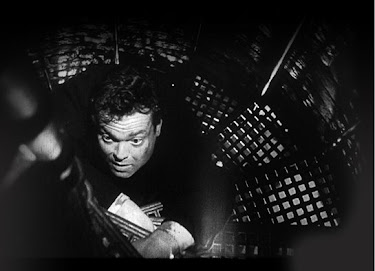
Where the Sidewalk Ends (1950) opens, appropriately, with Dana Andrews' and Gene Tierneys' names inscribed on the sidewalk, as dirty water streams down between the bars of a sewer grate. The sidewalk represents respectability, integrity and morality – only crooks and delinquents walk in the gutter. But even the most honourable of men have a tendency to misstep on occasion, and, when the sidewalk abruptly comes to an end, sometimes it proves impossible to avoid getting one's shoes wet. Mark Dixon (Dana Andrews) was born in the gutter, his father a professional criminal, and has spent his entire life clawing his way back onto the sidewalk, perpetually balanced on the edge of the kerb. As a police detective, Dixon wants nothing more than to display the decency and integrity that his father lacked, but he possesses a mean-streak that he can't escape. When his quick temper leaves a murder suspect dead, Dixon finds himself becoming the very father whom he despised, a cheap criminal who'll cheat and lie to cover up his offence.

Where the Sidewalk Ends was the only film to reunite Dana Andrews, Gene Tierney and director Otto Preminger after the superb Laura (1944), though the two films, as far as noir goes, couldn't be further apart. Whereas the earlier picture had the strong intimacy of a country-house murder tale, this film is more conventional as a gritty urban police drama. Given her ravishingly memorable performance as Laura Hunt, it's unfortunate that here Tierney is grossly underused, occupying the typical niche of the pretty, helpless romantic interest {much as she did that same year in Jules Dassin's The Night and the City (1950)}. Andrews, on the other hand, has rarely been better, exhibiting a toughness and unhinged anger that I hadn't expected of him. Gary Merrill is suitably smug as the crime boss Scalise, but he doesn't seem mean enough for the role, and I think that an actor like Richard Conte (who played Mr. Brown in The Big Combo (1955)) would have better suited the character; I hadn't realised this, but Conte appeared just one year earlier in Preminger's Whirlpool (1949).

The tension, as Dixon attempts to cover up his crime, is absolutely riveting – certainly among the most suspenseful sequences of its era – though I feel that the situation still wasn't exploited to its full potential. The taxi driver is the only person who could have decisively identified Dixon as the perpetrator, but Preminger hurriedly skims over the moment when he passes Dixon on the stairs. Had the witness been brought in as Dixon was re-enacting his own movements outside the apartment entrance, we could have had some genuine fireworks. And why, for that matter, couldn't the taxi driver's testimony have immediately absolved Jiggs Taylor (Tom Tully) from suspicion of murder? Niggling inconsistencies such as these tarnish an otherwise excellent screenplay from Ben Hecht, who infuses his gritty criminal underworld with hard-hitting cops and wise-cracking felons. Andrews' seething and implosive law-enforcer, tormented by rage and remorse, has rarely been done better, at least the equal of Robert Ryan in Nicholas Ray's On Dangerous Ground (1952).
8/10

Currently my #5 film of 1950:
1) Night and the City (Jules Dassin) *
2) Sunset Blvd. (Billy Wilder) *
3) Harvey (Henry Koster)
4) In a Lonely Place (Nicholas Ray) *
5) Where the Sidewalk Ends (Otto Preminger) *
6) Destination Moon (Irving Pichel)
7) All About Eve (Joseph L. Mankiewicz)
8) The Asphalt Jungle (John Huston) *
9) Panic in the Streets (Elia Kazan) *
10) Stage Fright (Alfred Hitchcock)

Read More...