Directed by: Otto Preminger
Written by: Marty Holland (novel), Harry Kleiner (writing)
Starring: Dana Andrews, Alice Faye, Linda Darnell, Charles Bickford, Anne Revere, John Carradine
WARNING: Plot and/or ending details may follow!!!
With Laura (1944) and Where the Sidewalk Ends (1950), director Otto Preminger and actor Dana Andrews collaborated to produce two of the great American film noirs. Fallen Angel (1945) also features this winning combination, but unfortunately lacks something more crucial: conviction. Eric Stanton (Andrews) is the perfect noir anti-hero, an unabashed shyster with a knack for opportunism. After stranding himself in a small American town with a dollar in his pocket, Stanton falls for Stella (Linda Darnell), a vivacious young waitress who'll "befriend" any man who can offer her financial security. Stanton claims that he wants to marry Stella, but he's obviously driven by lust, and his hunger leads him to seek money through dubious means – in this case, by wooing and marrying the spinsterish June (Alice Faye). Where Preminger fumbles is in his unwillingness to punish Stanton. Instead, the irresponsibly- flirtatious Stella is murdered, and our hero's innocence – never really doubted by the audience – distracts from the character's own moral crimes.

The film, at least, is thick with atmosphere. The small-town setting creates a distinct sense of claustrophobia, as though one can't run far enough to escape the watchful eyes of the local residents. Dana Andrews, as always, is excellent in the lead role. Linda Darnell exudes a trashy but undeniably voluptuous sensuality; she's a more openly sexual character than Gene Tierney's Laura, and perhaps more along the lines of Tierney in The Shanghai Gesture (1941) or Jean Peters in Pickup on South Street (1953). The characters played by Alice Faye and Anne Revere are underdeveloped and mostly uninteresting; their innocent, righteous personalities feel as though they should have no place in the film noir style. Charles Bickford, however, is very entertaining as a cocky and sadistic retired detective charged with solving Stella's murder. For the sizzling chemistry of Andrews and Darnell, Fallen Angel is a worthy enough noir thriller, but the director and star have done better, both together and with others.
6.5/10
Currently my #10 film of 1945:
1) The Lost Weekend (Billy Wilder) *
2) Spellbound (Alfred Hitchcock) *
3) Brief Encounter (David Lean)
4) 'I Know Where I'm Going!' (Michael Powell, Emeric Pressburger)
5) Perfect Strangers (Alexander Korda)
6) Leave Her to Heaven (John M. Stahl) *
7) Scarlet Street (Fritz Lang) *
8) And Then There Were None (René Clair)
9) Roma, città aperta {Rome, Open City} (Roberto Rossellini)
10) Fallen Angel (Otto Preminger) *


 Richard Conte was one of the most interesting leading men of his era. His big-shot crime boss in
  This slackening of tone is seen most tellingly in the film's dramatic climax, a confrontation between Garcos and Figlia. The sequence doesn't work because it's conflicted between two opposing moral viewpoints. In one sense, Dassin appears to advocate Garcos' vigilante action in subjecting Figlia to a physical beating, since he successfully reclaims his stolen payments and achieves some degree of mental closure regarding his father's crippling. However, at this moment, as Garcos collapses onto the bench in exhaustion, policemen enter the diner and arrest Figlia for his crimes – but not before one officer sternly wags his finger at Garcos for taking the law into his own hands. To have an excellent film intruded upon by such an awkward, juvenile moral lesson is bad enough, but the film could have gotten across the same message in a more powerful manner. As the police stormed into the diner, my blood had suddenly run cold with the chilling thought: what if Figlia is dead? Out of pure bloody-minded pride, a good man would have been condemned for life, the ultimate testament that vigilantism is not the answer.
 Foster's film opens in a pub, as the drunken patrons are shuffled into the street at closing time. There sits Bill Saunders (Lancaster) at the bar, lonely and brooding, so utterly distanced from society that he refuses to follow his fellow drinkers out the door. When the publican becomes forceful, Bill suddenly jerks into action, striking out with a heavy fist that leaves his aggressor dead on the floor. "Chum, you've been and gone and done it," remarks one stunned onlooker (Newton) gravely; "he's dead. You've killed him." This is what film noir is all about: that fundamental moment when there's no turning back. After a thrilling chase through the London streets (though I notice that the characters still drive left-handed vehicles), Bill finds refuge in the apartment of Jane Wharton (Fontaine), whose unexpected compassion leads him to seek a relationship with her. At this point, the film quickly and inexplicably forgets that Bill is a fugitive wanted for murder. Or, perhaps more accurately, it waits for us to forget.
 Only after Bill Saunders has reestablished his place in society does his past rear its ugly head, in the form of Robert Newton's grotesquely cavalier black-market fraudster. This isn't the first time in Lancaster's career that his character's past had inescapably returned to haunt him: in Siodmak's
  Underpinning The Naked City is producer Mark Hellinger's narration, which serves as both a prop and a vice. Absolutely essential is the final sign-off, which remarks "there are eight million stories in the Naked City. This has been one of them." Coming only moments after a murderer falls to his death from the Williamsburg Bridge, this narration assures us, as critic Luc Sante writes in his Criterion Collection essay, "that what we briefly experienced as a cosmic struggle up above the earth was really just another statistic." In a city of eight million people, such high-drama attains only passing significance: workers file past the apartment building where a young model was brutally murdered; children play jump-rope outside the office window of a detective embroiled in a homicide case; a street-sweeper cleans up yesterday's discarded newspaper, its headline "DEXTER MURDER SOLVED!" having since given way to more pertinent news. However, Hellinger's narration, which chimes in at regular intervals, can also be intrusive, and I disliked the cheerful, cloying manner in which it interacted with the characters, as in a contemporary newsreel.
 Despite revolving around a police procedural that has many of the classic dramatic ingredients – most memorably a suave jewel thief and pathological liar (Howard Duff) – it is only when detectives Muldoon (Barry Fitzgerald) and Halloran (Don Taylor) take to the streets that The Naked City really springs to life. Dassin filmed most of his exteriors out in the gritty urban walkways, often without the knowledge of bystanders, and the resultant atmosphere is fundamental to his storytelling style. New York simply seems so real, bustling with the minor details of activity – children playing in the streets, salesmen pushing their carts – that are impossible to duplicate on a studio backlot. However, rather than serving merely as a documentary portraiture of city life, as in Vertov's The Man with a Movie Camera (1929), the film's authentic environment instead functions to solidify the immediacy of the underlying drama. While Dassin's ability to juggle these disparate elements at times appears strained, he would perfect his method for what is, for my money, the director's masterpiece:
  The Killers opens with a superbly-thrilling prologue that sees two hired thugs (William Conrad and B-noir stalwart Charles McGraw) harass the patrons at a small-town diner on their way to assassinate boxer- turned-gangster Swede Andersen. The characters' quickfire exchange of dialogue resembles something that Quentin Tarantino or the Coen brothers would have written decades later, only better, because screenwriter Anthony Veiller (with Richard Brooks and John Huston) reproduces the conversation from Hemingway's short story almost verbatim. After Andersen is unresistingly gunned down in his bed, the screenplay then expands upon the foundations laid down by the source material, using flashbacks to fill in the empty spaces at which Hemingway had only hinted. Veiller, whose work before WWII was dominated by romantic dramas, comedies and light mysteries like The Ex-Mrs. Bradford (1936), appears to have been hardened by his work on Frank Capra's Why We Fight propaganda series, and the dark, cynical post-War tone he brings to Swede's tragic story is an ideal representation of the noir spirit.
  Burt Lancaster shows promise in his screen debut, though the film's narrative structure does keep the audience distant from his character, an issue that Welles somehow avoided in Citizen Kane. As the resident femme fatale, Ava Gardner never quite inspires the collective hatred garnered by Barbara Stanwyck in Double Indemnity (1944) or Jane Greer in Out of the Past (1947), but perhaps that speaks to her charms – that, despite her betrayal, we're still unwilling to treat her with due contempt. Good-guy Edmond O'Brien cheerfully and voyeuristically experiences the wretched life of a gangster through the intermediary flashback device – he ends the film with a cocky grin, like an audience-member emerging from a screening of the latest gangster thriller. Throughout this review, I've been making frequent allusions to Citizen Kane, but there's a very important difference between the two main characters: Charles Foster Kane had all the money in the world and got nothing out of it. Swede Andersen wasn't even that lucky; he didn't even get the money.
  Though one would stop short of calling this a film noir, there are certainly traces of the necessary elements. Most prominent is the theme of hidden family secrets, of a shameful past coming back to haunt wrongdoers, as in
  John Raden (Albert Dekker) is the film's hapless protagonist, an honest guy who unwillingly stumbles upon his family's dirty secret. Via a succession of ill-fated coincidences, implying the forces of Fate that would later pervade the film noir movement, John finds himself on trial for murder, thrust protestingly into an ad hoc mob trial that recalls Peter Lorre's judgement in M (1931). Dekker is excellent in the dual-roles of John and Paul Raden, with the "bad" half always distinguishable, not just by his grizzled beard and raggedy clothing, but by the way he carries himself: slouched shoulders, arms held awkwardly, innocent and perplexed eyes upturned at the eccentricities of this unfamiliar society. Susan Hayward plays Millie, a minor femme fatale. She's an angel when you first see her, but the way she knowingly toys with Paul's naivete is quite repulsive, and her nastiness during the courtroom trial is similarly brutal. Notably, director Stuart Heisler would progress on to full-blown noir the following year with his Hammett adaptation
  Bob Regan (O'Brien) is a two-bit lawyer with the bluster of a high-price attorney. In his first scene, Regan sidles through a busy reception office, offends a secretary (Raines) with some surprisingly-forward sexual banter, before busting in on millionaire businessman Andrew Colby (Price) and demanding the sum of exactly $68.72. Impressed with Regan's passion for the job, Colby hires him for a high-paying, two-week stint as a personal bodyguard. However, when Regan guns down Leopold Kroner (Fritz Leiber), a former associate of Colby's who was recently released from prison, he finds himself in hot water with detective Damico (Bendix), who scents murder. Desperate to clear his name, Regan begins to investigate Colby's shady dealings, reluctantly exploiting the affections of secretary Noel Faraday for information. Meanwhile, Vincent Price's articulate, calculating Colby plots the coup de grâce of his high-stakes crime spree, culminating in a murder frame-up that initially seems so airtight that I couldn't imagine any way for our hero to get out of it.
 Though it doesn't necessarily offer any new material for the film noir lexicon, nor does The Web feel contrived. The romance between O'Brien and Raines could easily have been squandered with melodrama, but the film always keeps their relationship edgy. Noel's affections, for one, are clearly split between Regan and Colby, whose association with her visibly extends beyond the professional realm ("I recognise him when I see him"). Regan himself, while essentially good-hearted, has a clumsy crudeness about him where women are concerned, in contrast with Colby, who always knows what to say and how to say it. There's something subtly fascinating about Price's 1940s performances; it has to do with how he speaks. When his character is telling an untruth, he does so in a manner that, to us, reeks of deception, and yet we can perfectly understand why the film's characters – say, a policeman – swallow the lie whole. He toes a fine line, and still manages to suspend the audience's disbelief. Maybe that's why Price got away with starring in so many bad movies.
 Lewis Milestone's The Strange Love of Martha Ivers (1946) is filled with Gothic atmosphere, the sort of hushed melodramatic whispers that follow around a household with something to hide – think Rebecca (1940) or Dragonwyck (1946). But the film never reaches its potential. Despite a running-time of nearly two hours, by the story's end, I felt as though nothing much had really happened, and that a perfectly good build-up had been smothered before reaching its climax and logical conclusion. There's no doubt that Barbara Stanwyck was cast in light of her icy Oscar-nominated performance in Double Indemnity (1944), but here it's uncertain whether her character is a tormented victim or a compassionless fiend. Such ambiguity might have been used to great effect, but here it merely suggests a confused script that can't decide whether to idolise or chastise its top-billed performer. Not to mention that Stanwyck herself doesn't appear until past the film's half- hour mark, the delay promising a colossal personality that eventually materialises only half-heartedly.
 Robert Wise was certainly one of Hollywood's most versatile directors, having released excellent films from almost every major genre – science-fiction, horror, drama, musical, war. The Set-Up was produced on a low budget by RKO, with a story that unfolds in real-time (predating Zinnemann's High Noon (1952), which famously used this approach). Despite a taut 72-minute running-time, the film packs a considerable emotional punch, as the sympathetic Stoker places his dignity on the line, sticks to his guns, and winds up being punished for his nobility. Robert Ryan gives a characteristically intense leading performance, eliciting empathy, but also exhibiting a quiet, understated dignity. When his fellow boxers emerge from their bouts, either ecstatic in victory or discouraged in defeat, there's a heartbreaking sadness in Stoker's eyes, as though every time he must front the challenge of his own aging body. Among the compelling supporting performers is David Clarke as a self-deluding washed-up boxer, and Alan Baxter (looking a bit like Frank Sinatra, I thought) as a cold-eyed gangster who wears sharp suits but, unlike Stoker, hasn't any class or principles.
 The Set-Up, in exposing the unglamorous side of the boxing profession, certainly served as inspiration for Martin Scorsese's Raging Bull (1980), and probably also influenced Kubrick in his early noir thriller Killer's Kiss (1955). The boxing match between Stoker and Tiger Nelson (Hal Fieberling) is an gritty four-round exchange of bludgeoning blows, and every connecting swipe sent a shudder of discomfort through my body. Even more fascinating, however, is how Wise focuses much attention on the match spectators, perhaps the most depraved selection of sadistic souls you're likely to find at any sporting event: an excited house-wife calls for a prolonging of the boxers' suffering; a blind man cries "go for his eyes," his cruel mind filling in the bloody details; the ever-composed Little Boy (Baxter) watches through shrewd, calculating eyes. The atmosphere of the boxing stadium is oppressive and stifling, the meeting-place of society's most decadent citizens. Ironically, it is only when he is defeated by this environment that Stoker can ever escape its clutches. He strikes the bottom of the barrel, his honour intact only in his eyes.


 I hadn't realised that Lake was so incredibly short. Having only seen her in three films opposite Alan Ladd, whose comparatively small stature made him an ideal screen partner, it was surprising to see the 6' 3" Joel McCrea positively tower above her. This must have caused headaches for the cinematographer who was valiantly trying to frame both stars into every shot. Nevertheless, Lake doesn't let her petite size get in the way of a solid performance, and, indeed, her character is surprisingly malevolent. Borrowing a leaf from the femme fatales of the film noir style, which was in full swing by the late 1940s, Lake's Connie Dickason is a feisty customer, a pugnacious ranch-woman whose determination to upset the balance of power in her small western town turns her as nasty as the male oppressors whom she so despises. She deliberately breaks the law to achieve her self-righteous ends, and attempts to rope men into her scheme through the promise of sex. Yet Connie remains a moderately sympathetic character.
 Pat O'Brien is typically known for playing priests, the level-headed foil for James Cagney's explosive gangster. In other words, he's usually the least-interesting character in the film. Crack-Up (1946) marks a welcome change-of-pace for the actor. No longer is O'Brien the calm, collected cleric, but a confused art critic at the end of his rope, doubting his own sanity as he battles murder and conspiracy. He perhaps isn't perfect for the role – the film's lurid moments would have been even more lurid had the lead actor been able to act more deranged – but O'Brien receives good supporting back-up from Claire Trevor, Herbert Marshall and Ray Collins. Director Irving Reis (best known for his "Falcon" series, though he also co-directed the annoyingly manipulative Hitler's Children (1943) with Edward Dmytryk) does well to develop the film's mood, not afraid to dabble in a bit of surrealism to help translate the mental confusion and degradation of his main protagonist. There's also a little Freudian psychoanalysis in there, as was popular at the time, but the distraction it causes to the story is only an afterthought.
 Journey into Fear is one of those rare WWII-themed films of the early 1940s that you wouldn't automatically class as propaganda. Indeed, the Nazis are only mentioned in passing, and the sinister agents who attempt to assassinate Cotten could just as easily be motivated by reasons other than war. Much of the story takes place on a small passenger ship, on which American engineer Howard Graham (Cotten) seeks refuge from German assassins, who are hell-bent on delaying his return home with important Allied intelligence. Silent enemy Peter Banat (played by Welles' agent, Jack Moss) watches ominously from across the ship's cabin, never saying a word, but suggesting sadistic menace through every dryly-amused smirk. Cotten is strong in the lead role, playing Graham as a frightened and confused amateur, a role reminiscent of Holly Martins from The Third Man (1949), rather than the experienced and resourceful American spy we would otherwise expect in such a film. Welles lends his mighty presence to the role of the Turkish Colonel Haki, though he is noticeably more subdued than usual.
  In one final manner, Journey into Evil is very much like an Orson Welles film: it was re-edited at the studio's request. According to some sources, Welles did some of the trimming himself, recutting the final reel and adding Joseph Cotten's rather awkward narration. At just 68 minutes in length, the film certainly feels as though it has been tampered with. The relationship between Graham and Rosette (Dolores del Rio) is brief and poorly explored, and certainly not worthy of the repeated reassurances that the former frequently bestows upon his anxious wife (Ruth Warrick); there's little indication that their affiliation extended beyond exchanging a few harmless pleasantries. Though the film doesn't exactly feel incomplete – as did a noir like Renoir's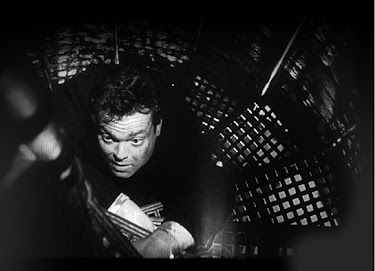


_poster.jpg)


