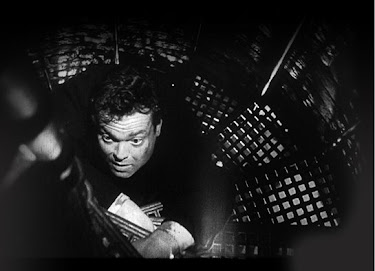
Directed by: Orson Welles
Written by: Orson Welles (story & screenplay)
Starring: Orson Welles, Robert Arden, Michael Redgrave, Patricia Medina, Akim Tamiroff, Mischa Auer, Paola Mori, Katina Paxinou, Grégoire Aslan, Peter van Eyck, Suzanne Flon
 WARNING: Plot and/or ending details may follow!!! [Paragraph 3 Only]
If one must choose a film with which to compare Mr. Arkadin, it would probably be Carol Reed's The Third Man (1949). Both pictures transplant a familiar film noir plot into a European setting, and an eccentric camera captures the personality of the exotic locales and their inhabitants. Both, of course, also starred Orson Welles in a prominent role, and playing analogous characters. In Reed's film, Harry Lime is a smug, boyish racketeer whose thirst for ill-gotten profits takes priority over the faceless victims of his black-market crimes. Gregory Arkadin might be considered an extension of Lime's character, had he emerged unscathed from the Vienna sewers and lived years more. Arkadin is undoubtedly a criminal, but one whose incredible success has pushed him beyond such a characterisation. Despite having apparently eluded his youthful years in petty crime (after erasing his former identity, much as Lime attempted), Arkadin remains plagued by the shame of his past, unwilling to acknowledge that he is just as contemptible now as he ever was.
Despite the thematic influence of American cinema, Welles' direction, stylistically, more closely resembles the work of European artists like Federico Fellini. His dynamic camera-work and editing has an air of improvisation, and a certain flamboyance that might seem overindulgent if it weren't so brilliantly effortless. The film's most interesting sequence is an early costume ball in which guests are hidden behind grotesque masks, whose massive features crowd the frame like the creatures from Maurice Sendak's "Where the Wild Things Are." Though it is Welles' presence that dominates the screen, Robert Arden is an intriguing noir protagonist: Guy Van Stratten is a small-time smuggler (once again drawing a parallel with Harry Lime) who epitomises the petty crook that Arkadin once was. Infatuated with nothing but money and self- preservation, Stratten continually exploits the affections of girlfriend Mily (Patricia Medina) and Arkadin's daughter Raina (Paola Mori). He destroys the lives of both women, and, unremorsefully, manages to save his own neck. Gregory Arkadin isn't the only villain on this cluttered continent.
8/10
Currently my #5 film of 1955:
1) Du rififi chez les hommes {Rififi} (Jules Dassin) *
2) The Ladykillers (Alexander Mackendrick)
3) Bad Day at Black Rock (John Sturges)
4) Kiss Me Deadly (Robert Aldrich) *
5) Mr. Arkadin {Confidential Report} (Orson Welles) *
6) The Big Combo (Joseph H. Lewis) *
7) Les Diaboliques (Henri-Georges Clouzot) *
8) Nuit et brouillard {Night and Fog} (Alain Resnais)
9) Rebel Without a Cause (Nicholas Ray)
10) The Night of the Hunter (Charles Laughton) *

 Journey into Fear is one of those rare WWII-themed films of the early 1940s that you wouldn't automatically class as propaganda. Indeed, the Nazis are only mentioned in passing, and the sinister agents who attempt to assassinate Cotten could just as easily be motivated by reasons other than war. Much of the story takes place on a small passenger ship, on which American engineer Howard Graham (Cotten) seeks refuge from German assassins, who are hell-bent on delaying his return home with important Allied intelligence. Silent enemy Peter Banat (played by Welles' agent, Jack Moss) watches ominously from across the ship's cabin, never saying a word, but suggesting sadistic menace through every dryly-amused smirk. Cotten is strong in the lead role, playing Graham as a frightened and confused amateur, a role reminiscent of Holly Martins from The Third Man (1949), rather than the experienced and resourceful American spy we would otherwise expect in such a film. Welles lends his mighty presence to the role of the Turkish Colonel Haki, though he is noticeably more subdued than usual.
 In one final manner, Journey into Evil is very much like an Orson Welles film: it was re-edited at the studio's request. According to some sources, Welles did some of the trimming himself, recutting the final reel and adding Joseph Cotten's rather awkward narration. At just 68 minutes in length, the film certainly feels as though it has been tampered with. The relationship between Graham and Rosette (Dolores del Rio) is brief and poorly explored, and certainly not worthy of the repeated reassurances that the former frequently bestows upon his anxious wife (Ruth Warrick); there's little indication that their affiliation extended beyond exchanging a few harmless pleasantries. Though the film doesn't exactly feel incomplete – as did a noir like Renoir's