Directed by: John Boulting
Written by: Graham Greene (novel & screenplay), Terrence Ratigan (writer)
Starring: Richard Attenborough, Carol Marsh, Hermione Baddeley, William Hartnell, Harcourt Williams, Wylie Watson
In John Boulting's adaptation of a Graham Greene novel, Richard Attenborough plays small-time gang-leader Pinkie Brown, a young man with a rough temper and a paranoid mean-streak. After he murders a police informer, Pinkie happens upon a young waitress (Carol Marsh) who could shatter his alibi if she wanted to. Unable to silence her without risking arrest, Pinkie instead tries to seduce the girl, who naively falls head over heels for the man who'd like to put a bullet in her.
Greene's trademark wryness is present in a tense opening act that sees a desperate newspaper employee (hired as Kolley Kibber, a variation of the Lobby Lud character) pursued through the streets of Brighton. Rarely have bustling crowds of people felt so ominous: how can this man hope to escape detection if, in a sardonic twist, an entire readership is looking out for him? Pinkie eventually murders the man during a carnival horror ride, escaping into the throngs of oblivious day-trippers. The man in which such a heinous crime is swallowed by the clamour of everyday life recalls Dassins The Naked City (1948) and that wonderful reverse dolly shot in Hitchcock's Frenzy (1972).


This sequence is one of several – including the climax upon a foggy ocean pier – whose sheer atmosphere is intense enough to rival the very best noir efforts of Jules Dassin {Night and the City (1950)} and Carol Reed {Odd Man Out (1947); The Third Man (1949)}. Unfortunately, unlike these better films, Brighton Rock (1947) lacks a consistent tone. Director Robert Boulton is skillful at building a strong atmosphere, but intermittent interruptions from Hermione Baddeley's brassy amateur sleuth (accompanied by her own jaunty theme tune) shift the mood from that of a grim British noir to a frivolous Miss Marple outing.
Though Richard Attenborough is a small, unintimidating actor, he somehow uses his slight stature to his advantage. Like a wily mutt, his Pinkie Brown has a ferocious bark, and a bite to match. In stories of this sort, it is typical for the villain to be softened, if only slightly, by the affections of a pretty lady. Nothing of the sort happens here. Pinkie, whose sexual urges are seemingly exhausted in his lust for power, woos and weds waitress Rose purely as an exercise in self-preservation. The young woman's devotion to such a cold-blooded crook is pathetic and heartbreaking, a tragic metaphor for thousands of women trapped in loveless and abusive marital unions.
7/10
Currently my #10 film of 1947:
1) Odd Man Out (Carol Reed) *
2) The Ghost and Mrs. Muir (Joseph L. Mankiewicz)
3) Monsieur Verdoux (Charles Chaplin)
4) Out of the Past (Jacques Tourneur) *
5) Dark Passage (Delmer Daves) *
6) The Lady from Shanghai (Orson Welles) *
7) They Won’t Believe Me (Irving Pichel) *
8) The Web (Michael Gordon) *
9) The Fugitive (John Ford, Emilio Fernández)
10) Brighton Rock (John Boulting) *


 Bob Regan (O'Brien) is a two-bit lawyer with the bluster of a high-price attorney. In his first scene, Regan sidles through a busy reception office, offends a secretary (Raines) with some surprisingly-forward sexual banter, before busting in on millionaire businessman Andrew Colby (Price) and demanding the sum of exactly $68.72. Impressed with Regan's passion for the job, Colby hires him for a high-paying, two-week stint as a personal bodyguard. However, when Regan guns down Leopold Kroner (Fritz Leiber), a former associate of Colby's who was recently released from prison, he finds himself in hot water with detective Damico (Bendix), who scents murder. Desperate to clear his name, Regan begins to investigate Colby's shady dealings, reluctantly exploiting the affections of secretary Noel Faraday for information. Meanwhile, Vincent Price's articulate, calculating Colby plots the coup de grâce of his high-stakes crime spree, culminating in a murder frame-up that initially seems so airtight that I couldn't imagine any way for our hero to get out of it.
 Though it doesn't necessarily offer any new material for the film noir lexicon, nor does The Web feel contrived. The romance between O'Brien and Raines could easily have been squandered with melodrama, but the film always keeps their relationship edgy. Noel's affections, for one, are clearly split between Regan and Colby, whose association with her visibly extends beyond the professional realm ("I recognise him when I see him"). Regan himself, while essentially good-hearted, has a clumsy crudeness about him where women are concerned, in contrast with Colby, who always knows what to say and how to say it. There's something subtly fascinating about Price's 1940s performances; it has to do with how he speaks. When his character is telling an untruth, he does so in a manner that, to us, reeks of deception, and yet we can perfectly understand why the film's characters – say, a policeman – swallow the lie whole. He toes a fine line, and still manages to suspend the audience's disbelief. Maybe that's why Price got away with starring in so many bad movies.
 I hadn't realised that Lake was so incredibly short. Having only seen her in three films opposite Alan Ladd, whose comparatively small stature made him an ideal screen partner, it was surprising to see the 6' 3" Joel McCrea positively tower above her. This must have caused headaches for the cinematographer who was valiantly trying to frame both stars into every shot. Nevertheless, Lake doesn't let her petite size get in the way of a solid performance, and, indeed, her character is surprisingly malevolent. Borrowing a leaf from the femme fatales of the film noir style, which was in full swing by the late 1940s, Lake's Connie Dickason is a feisty customer, a pugnacious ranch-woman whose determination to upset the balance of power in her small western town turns her as nasty as the male oppressors whom she so despises. She deliberately breaks the law to achieve her self-righteous ends, and attempts to rope men into her scheme through the promise of sex. Yet Connie remains a moderately sympathetic character.
 Robert Ryan plays Scott, a coastguard who suffers from regular night terrors concerning memories of a war-time naval tragedy, when his ship was presumably torpedoed. His dream sequences are gripping and otherwordly, recalling the excellently surreal work achieved by Renoir in his silent short film, The Little Match Girl (1928). During his nightmares, Scott imagines an underwater romantic liaison, which, before he can get intimate, unexpectedly blows up in his face; this is an apt indication of the events that unfold later in the film. Scott is engaged to marry the pretty Eve (Nan Leslie), but his attention is soon distracted by Peggy (Joan Bennett), the titular "woman on the beach." Peggy is married to Tod (Charles Bickford), a famous blind artist who is still coming to terms with his relatively recent affliction. At just 71 minutes in length, Woman on the Beach feels far too short, the apparent victim of studio interference. Scott is obviously enamoured, and later obsessed, with femme fatale Peggy, in a manner than suggests Walter Neff's fixation with Phyllis Dietrichson, but the motivations behind his actions are inadequately explored and explained.
 Perhaps as a result of the studio's trimming of scenes, many plot-twists in the film seem somewhat contrived. Scott's extreme determination in proving that Tod is faking blindness feels so incredibly illogical – why, indeed, would Tod even consider such a con? Many wonderful scenes are severely hampered by the story's lack of exposition. In the film's most dramatic scene, amid the choppy waters of the Atlantic, Robert Ryan displays a frighteningly convincing rage that borders on pure psychosis, a quality that Nicholas Ray exploited five years later in On Dangerous Ground (1952). However, because Scott's obsession and emotional transformation had previously been explored so sparsely, the sequence feels, above all else, out of context. The performances are neverthless solid across the board, with Bickford probably the most impressive. Bennett's character is tantalisingly ambiguous: throughout the film, she slowly reveals herself to be nothing but a greedy tramp, though Scott insists on treating her as a tormented victim of abuse. The ending offers little in the way of resolution, reaffirming the sentiment that perhaps this film isn't all there.
 Sandra Carpenter (Ball) is a smart-mouthed taxi dancer, the sort of girl who doesn't take any nonsense from the opposite sex. When her colleague goes missing after answering an ad in the newspaper personals column, the police suspect that she is the latest victim of a deranged serial killer, who sends the authorities flowery poetry readings to boast of his crimes. To prevent the next murder, Sandra is unexpectedly recruited to identify the man responsible, going undercover as his next prospective victim. Among the suspects is Boris Karloff, unfortunately underused as a hilariously demented fashion designer, and George Sanders, playing one of those charmingly smug suitors that he always played so well. Veteran cinematographer William Daniel's creates a nice, moody black-and-white atmosphere, perhaps lacking the grittiness of your typical 1940s film noir, though that would hardly have worked alongside a screenplay where even the most depraved murderers speak with a high degree of elegance and sophistication. Apparently, that's just how everybody is in England.
 The first half of the film delicately develops a mysterious and slightly Gothic air of uneasiness, and then something happens: Douglas Sirks' melodramatic instincts kick in, and his characters suddenly become less interesting than before. Lucille Ball's sassy and independent woman becomes enamoured with George Sanders, discarding all her saucy wise-cracks in favour of the anguished cries of a weepy and vulnerable damsel-in-distress. Sanders, likewise, is effectively neutered by the onset of love, losing his indomitable lust and becoming all quiet and contemplative. George Sanders quiet and contemplative, you say? Outrageous! Even so, Cedric Hardwicke singlehandedly rescues the film's final half, refusing to subdue his grotesque depravity even before we're supposed to guess that he's the man responsible for the serial murders. I don't know if I could confidently recommend Lured to fans of Douglas Sirk, but the excellent cast of actors means that most viewers should find some degree of fulfillment in his unusual brand of film noir film-making. This is worth a look.
 Setting aside the gimmick – which MGM optimistically hailed as the greatest cinematic innovation since synchronised sound – Lady in the Lake doesn't quite measure up to other popular Chandler adaptations of the time. Robert Montgomery may have been a great actor – I honestly can't say, this being my first film with him – but his Philip Marlowe doesn't possess the toughness of Bogart in The Big Sleep (1946), nor the cocky swagger of Dick Powell in Murder, My Sweet (1944). The awkwardness of the role is only accentuated by Marlowe's constantly being behind the camera, though even the occasional direct-to-camera interruptions seem to miss the mark. I don't expect that the supporting actors had much experience in speaking directly to a piece of equipment, and so their performances are capable without being particularly memorable. The chemistry between Montgomery and Audrey Totter, the potentially-villainous femme fatale, was mostly stale for this reason, as we're really only seeing one side of their conversation.
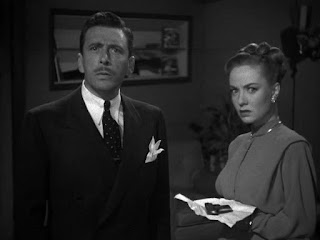 Perhaps the film's greatest weakness – and, once again, this all comes back to Montgomery's chosen gimmick – is that everything moves so slowly. One would expect those 1940s movie cameras to have been incredibly clunky, and so, in these pre-Steadicam days, Marlowe ambles from A to B with devastating sluggishness. The first-person technique, however, did work wonderfully in the sequence where Marlowe is being pursued in his car, and also when he must drag himself across the gravel to a public telephone. There are lots of prolonged silences where nothing happens, and, despite striving for realism, the film should have conceded more of a musical soundtrack to fill these voids. The one piece of music put into use, however, was an eerily effective choir song that reminded me of György Ligeti's "Requiem" from 2001: A Space Odyssey (1968). Overall, Lady in the Lake is a fascinating film noir experiment that doesn't quite manage to pull it off. Even so, it's worth a look for its unique take on Philip Marlowe and several scenes of inarguable excellence.
 There are three women in this story. Greta (Rita Johnson) is Ballentine's husband, an upright and charismatic businesswoman from a wealthy family, who knows both how her husband operates, and how she can control him with the promise of money. Verna Carlson (Susan Hayward), Ballentine's mistress, is a slick and crafty money-grabber. The couple, at least initially, have no delusions about their relationship: Verna is in it for his money, and he's in it for the sex (this theme, owing to the Production Code, is dealt with tastefully). Hayward plays the role to feisty perfection, and such was her cloaked malevolence that I half-expected her to crop up at the film's end, having somehow faked her own death, stolen Ballentine's money and skipped off to South America. Janice Bell (Jane Greer) is the polar converse of Hayward's femme fatale, perhaps the closest thing to love in Ballentine's life – their relationship, characterised by a mutual love of boating, apparently, seems genuinely platonic, a mutual understanding that our male hero promptly severs with his unquenchable thirst for wealth.
 I was surprised, given its relative obscurity nowadays, at just how strong a film They Won't Believe Me turned out to be. The main and supporting characters are played flawlessly, their traits and motivations explored with more than sufficient depth to justify their later actions, though one still wonders if Verna's apparent sincerity prior to the road accident is, indeed, genuine. As he recounts his tale to the murder jury, Ballentine frequently makes fatalistic allusions towards the inescapably of Fate – here personified in a crippled palomino horse. By the time he's finished telling his incredible story, which may or may not be true {Hitchcock pulled this false-flashback trick several years later, though I won't reveal the details}, we're left with a very raw taste in our mouths. We can sympathise to an extent with Ballentine's extraordinary run of bad luck, but much of his behaviour, even if one excludes the accusation of murder, is so utterly contemptible that he doesn't deserve to live. Yet, from the moment Ballentine catches a bullet in the back, we already know what the jury's verdict had been.
 The chemistry between Bogart and Bacall doesn't quite sizzle here as it usually does, and that our hero spends much of his time behind the camera certainly doesn't help. The film is strongest when it spends time with its supporting characters, which makes me think that Dark Passage might have been a better film had it been cast with relative unknowns. Daves obviously produced the film with one eye on his prized romantic couple, and the accompanying marketing opportunities, and, consequently, the story often tries too hard to create a memorable romance. Though the plot begins to meander towards the predictable in its final reel, the opening acts prove especially engrossing, not only because of the intriguing camera gimmick, but because we absolutely have no idea where this unusual story, with its cast of incredibly offbeat characters, is trying to lead us. It's also rewarding to try and guess how long Jack Warner could tolerate not seeing Humphrey Bogart's face until he threatened to shoot somebody; I think we can safely estimate this figure to sit just beyond one hour.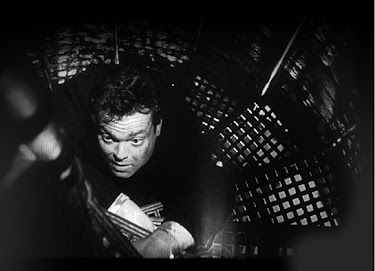


_poster.jpg)


