Directed by: Dick Richards
Written by: Raymond Chandler (novel), David Zelag Goodman (screenplay)
Starring: Robert Mitchum, Charlotte Rampling, Sylvia Miles, Harry Dean Stanton, Jack O'Halloran, Sylvester Stallone
The work of Raymond Chandler experienced a resurgence in the 1970s, thanks to Robert Altman's The Long Goodbye (1973) and Roman Polanski's very Chandler-ish Chinatown (1974). The waning career of Robert Mitchum was also revived by two Chandler adaptations, Farewell, My Lovely (1975) {previously filmed by Edward Dmytryk as Murder, My Sweet (1944)} and The Big Sleep (1978) {previously filmed by Howard Hawks}. Though outside the traditionally-accepted film noir period (approx. 1940-1958), the 1970s provided an ideal climate for a resurgence of the style. The demise of the Production Code in the 1960s had allowed filmmakers the freedom to explore more explicit themes, usually implying an increase in language, violence and nudity. Chandler's novels – which typically dabbled in themes of prostitution, homosexuality and pornography – could now be adapted faithfully without the threat of censorship, though fortunately, in the case of this particular film, director Dick Richards doesn't overdo the sleaze. The source material is one of the few Marlowe novels I haven't read, but Farewell, My Lovely nevertheless seems a loyal interpretation of the author's style.
The work of Raymond Chandler experienced a resurgence in the 1970s, thanks to Robert Altman's The Long Goodbye (1973) and Roman Polanski's very Chandler-ish Chinatown (1974). The waning career of Robert Mitchum was also revived by two Chandler adaptations, Farewell, My Lovely (1975) {previously filmed by Edward Dmytryk as Murder, My Sweet (1944)} and The Big Sleep (1978) {previously filmed by Howard Hawks}. Though outside the traditionally-accepted film noir period (approx. 1940-1958), the 1970s provided an ideal climate for a resurgence of the style. The demise of the Production Code in the 1960s had allowed filmmakers the freedom to explore more explicit themes, usually implying an increase in language, violence and nudity. Chandler's novels – which typically dabbled in themes of prostitution, homosexuality and pornography – could now be adapted faithfully without the threat of censorship, though fortunately, in the case of this particular film, director Dick Richards doesn't overdo the sleaze. The source material is one of the few Marlowe novels I haven't read, but Farewell, My Lovely nevertheless seems a loyal interpretation of the author's style.
 Philip Marlowe is the sort of role that Robert Mitchum would have nailed in the 1950s, when he always seemed to feel old and weary without actually looking it. Nevertheless – though he lacks the cocky vigour of Dick Powell, or the invincibility of Humphrey Bogart – the aging Mitchum does communicate what is perhaps Marlowe's most defining characteristic: that of a disillusioned, world-weary private dick looking for something in this world, anything, worth fighting for. In his latest case, Marlowe is hired by fearless lug Moose Malloy (Jack O'Halloran) to find his girlfriend Velma, who vanished while Malloy was serving a prison sentence. As always, what had initially seemed a straightforward assignment soon gets Marlowe embroiled in a complex patchwork of deceits, murders and double-crossings. Crucial to the mystery is Charlotte Rampling (emulating Lauren Bacall) as the adulterous wife of an old millionaire, and Oscar-nominated Sylvia Myles as an alcoholic performance artist. Also look out for small roles from Harry Dean Stanton as Det. Rolfe, and Sylvester Stallone as a lustful thug.
 Farewell, My Lovely does a fine job of translating Chandler's pessimistic vision of urban decay and human depravity. The 1940s adaptations are, of course, superbly entertaining, but most of them – particularly The Big Sleep (1946) and Lady in the Lake (1947) – are clearly filmed on a pristine studio set, somewhat offsetting the grittiness of Chandler's characters and plot. Richards' film, to his credit, is incredibly ugly. Aside from Helen Grayle, whose sprawling mansion suffers next to Buckingham Palace, most of Marlowe's witnesses live in appalling squalor; even his own office is drab and bathed in shadow. Yet, despite the unpolished milieu, Farewell, My Lovely most assuredly has a heart. Marlowe's wordless interactions with the son of a penniless musician help us see beneath the detective's front of indifference, hinting at his admiration for the honest working-class, and his fervent distaste towards the decadence of the wealthy. When offered his own wealth, Marlowe unthinkingly surrenders it to someone he deems more worthy, a touching but cheerless ending to a film steeped in the unpleasantness of human existence.
7/10
Currently my #6 film of 1975:
1) One Flew Over The Cuckoo’s Nest (Milos Forman)
2) Dersu Uzala (Akira Kurosawa)
3) Love and Death (Woody Allen)
4) Pasqualino Settebellezze {Seven Beauties} (Lina Wertmüller)
5) Jaws (Steven Spielberg)
6) Farewell, My Lovely (Dick Richards) *
7) Dog Day Afternoon (Sidney Lumet)
8) Monty Python and the Holy Grail (Terry Gilliam, Terry Jones)
2) Dersu Uzala (Akira Kurosawa)
3) Love and Death (Woody Allen)
4) Pasqualino Settebellezze {Seven Beauties} (Lina Wertmüller)
5) Jaws (Steven Spielberg)
6) Farewell, My Lovely (Dick Richards) *
7) Dog Day Afternoon (Sidney Lumet)
8) Monty Python and the Holy Grail (Terry Gilliam, Terry Jones)

 Setting aside the gimmick – which MGM optimistically hailed as the greatest cinematic innovation since synchronised sound – Lady in the Lake doesn't quite measure up to other popular Chandler adaptations of the time. Robert Montgomery may have been a great actor – I honestly can't say, this being my first film with him – but his Philip Marlowe doesn't possess the toughness of Bogart in The Big Sleep (1946), nor the cocky swagger of Dick Powell in Murder, My Sweet (1944). The awkwardness of the role is only accentuated by Marlowe's constantly being behind the camera, though even the occasional direct-to-camera interruptions seem to miss the mark. I don't expect that the supporting actors had much experience in speaking directly to a piece of equipment, and so their performances are capable without being particularly memorable. The chemistry between Montgomery and Audrey Totter, the potentially-villainous femme fatale, was mostly stale for this reason, as we're really only seeing one side of their conversation.
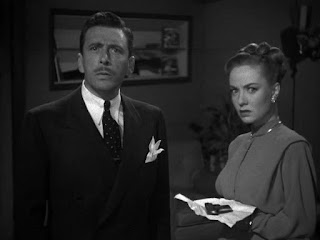 Perhaps the film's greatest weakness – and, once again, this all comes back to Montgomery's chosen gimmick – is that everything moves so slowly. One would expect those 1940s movie cameras to have been incredibly clunky, and so, in these pre-Steadicam days, Marlowe ambles from A to B with devastating sluggishness. The first-person technique, however, did work wonderfully in the sequence where Marlowe is being pursued in his car, and also when he must drag himself across the gravel to a public telephone. There are lots of prolonged silences where nothing happens, and, despite striving for realism, the film should have conceded more of a musical soundtrack to fill these voids. The one piece of music put into use, however, was an eerily effective choir song that reminded me of György Ligeti's "Requiem" from 2001: A Space Odyssey (1968). Overall, Lady in the Lake is a fascinating film noir experiment that doesn't quite manage to pull it off. Even so, it's worth a look for its unique take on Philip Marlowe and several scenes of inarguable excellence.
 Of course, Ladd is joined in the film by his previous co-stars from
  I suppose that film noir, at its heart, is all about fate, and how it never works in our favour. If something can go wrong, it will. Audiences have always been willing to suspend disbelief on such unlikely coincidences, but I think that here Chandler bites off more than he could chew. Not only does Bendix unknowingly go off with Ladd's adulterous wife (an acceptable enough twist of chance), but, of all the rain-soaked people that Lake might have picked up off the side of the road, it happens to be the very person whose soon-to-be-deceased wife was having an affair with her husband. Had the pair met outside, say, Harwood's night-club, this happenstance might have been easier to digest, but, as it stands, the absurd coincidence only distracts from the storyline. No matter – the story itself is filled with unlikable characters and dubious motives, and with gunfire and murder in great abundance. Getting beaten up was always something that Ladd could accomplish most convincingly, and his frantic tussle with two armed gangsters is the highlight of the film.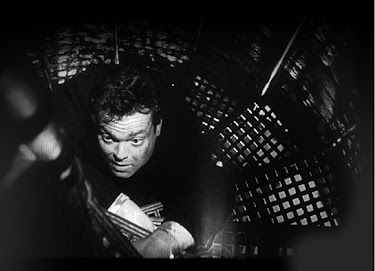


_poster.jpg)


