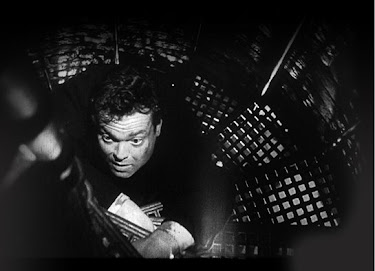
Directed by: Otto Preminger
Written by: William L. Stuart (novel), Ben Hecht (screenplay), Victor Trivas (adaptation), Frank P. Rosenberg (adaptation), Robert E. Kent (adaptation)
Starring: Dana Andrews, Gene Tierney, Gary Merrill, Bert Freed, Tom Tully, Karl Malden, Ruth Donnelly, Craig Stevens
Where the Sidewalk Ends (1950) opens, appropriately, with Dana Andrews' and Gene Tierneys' names inscribed on the sidewalk, as dirty water streams down between the bars of a sewer grate. The sidewalk represents respectability, integrity and morality – only crooks and delinquents walk in the gutter. But even the most honourable of men have a tendency to misstep on occasion, and, when the sidewalk abruptly comes to an end, sometimes it proves impossible to avoid getting one's shoes wet. Mark Dixon (Dana Andrews) was born in the gutter, his father a professional criminal, and has spent his entire life clawing his way back onto the sidewalk, perpetually balanced on the edge of the kerb. As a police detective, Dixon wants nothing more than to display the decency and integrity that his father lacked, but he possesses a mean-streak that he can't escape. When his quick temper leaves a murder suspect dead, Dixon finds himself becoming the very father whom he despised, a cheap criminal who'll cheat and lie to cover up his offence.
 Where the Sidewalk Ends was the only film to reunite Dana Andrews, Gene Tierney and director Otto Preminger after the superb Laura (1944), though the two films, as far as noir goes, couldn't be further apart. Whereas the earlier picture had the strong intimacy of a country-house murder tale, this film is more conventional as a gritty urban police drama. Given her ravishingly memorable performance as Laura Hunt, it's unfortunate that here Tierney is grossly underused, occupying the typical niche of the pretty, helpless romantic interest {much as she did that same year in Jules Dassin's The Night and the City (1950)}. Andrews, on the other hand, has rarely been better, exhibiting a toughness and unhinged anger that I hadn't expected of him. Gary Merrill is suitably smug as the crime boss Scalise, but he doesn't seem mean enough for the role, and I think that an actor like Richard Conte (who played Mr. Brown in The Big Combo (1955)) would have better suited the character; I hadn't realised this, but Conte appeared just one year earlier in Preminger's Whirlpool (1949).
 The tension, as Dixon attempts to cover up his crime, is absolutely riveting – certainly among the most suspenseful sequences of its era – though I feel that the situation still wasn't exploited to its full potential. The taxi driver is the only person who could have decisively identified Dixon as the perpetrator, but Preminger hurriedly skims over the moment when he passes Dixon on the stairs. Had the witness been brought in as Dixon was re-enacting his own movements outside the apartment entrance, we could have had some genuine fireworks. And why, for that matter, couldn't the taxi driver's testimony have immediately absolved Jiggs Taylor (Tom Tully) from suspicion of murder? Niggling inconsistencies such as these tarnish an otherwise excellent screenplay from Ben Hecht, who infuses his gritty criminal underworld with hard-hitting cops and wise-cracking felons. Andrews' seething and implosive law-enforcer, tormented by rage and remorse, has rarely been done better, at least the equal of Robert Ryan in Nicholas Ray's On Dangerous Ground (1952).
8/10
Currently my #5 film of 1950:
1) Night and the City (Jules Dassin) *
2) Sunset Blvd. (Billy Wilder) *
3) Harvey (Henry Koster)
4) In a Lonely Place (Nicholas Ray) *
5) Where the Sidewalk Ends (Otto Preminger) *
6) Destination Moon (Irving Pichel)
7) All About Eve (Joseph L. Mankiewicz)
8) The Asphalt Jungle (John Huston) *
9) Panic in the Streets (Elia Kazan) *
10) Stage Fright (Alfred Hitchcock)

 Setting aside the gimmick – which MGM optimistically hailed as the greatest cinematic innovation since synchronised sound – Lady in the Lake doesn't quite measure up to other popular Chandler adaptations of the time. Robert Montgomery may have been a great actor – I honestly can't say, this being my first film with him – but his Philip Marlowe doesn't possess the toughness of Bogart in The Big Sleep (1946), nor the cocky swagger of Dick Powell in Murder, My Sweet (1944). The awkwardness of the role is only accentuated by Marlowe's constantly being behind the camera, though even the occasional direct-to-camera interruptions seem to miss the mark. I don't expect that the supporting actors had much experience in speaking directly to a piece of equipment, and so their performances are capable without being particularly memorable. The chemistry between Montgomery and Audrey Totter, the potentially-villainous femme fatale, was mostly stale for this reason, as we're really only seeing one side of their conversation.
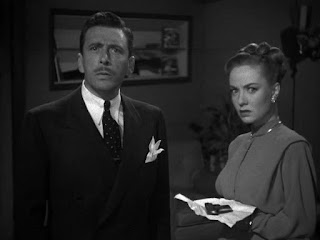 Perhaps the film's greatest weakness – and, once again, this all comes back to Montgomery's chosen gimmick – is that everything moves so slowly. One would expect those 1940s movie cameras to have been incredibly clunky, and so, in these pre-Steadicam days, Marlowe ambles from A to B with devastating sluggishness. The first-person technique, however, did work wonderfully in the sequence where Marlowe is being pursued in his car, and also when he must drag himself across the gravel to a public telephone. There are lots of prolonged silences where nothing happens, and, despite striving for realism, the film should have conceded more of a musical soundtrack to fill these voids. The one piece of music put into use, however, was an eerily effective choir song that reminded me of György Ligeti's "Requiem" from 2001: A Space Odyssey (1968). Overall, Lady in the Lake is a fascinating film noir experiment that doesn't quite manage to pull it off. Even so, it's worth a look for its unique take on Philip Marlowe and several scenes of inarguable excellence.