Directed by: Norman Foster
Written by: Gerald Butler (novel), Walter Bernstein (adaptation), Ben Maddow (adaptation), Leonardo Bercovici (writer), Hugh Gray (additional dialogue)
Starring: Joan Fontaine, Burt Lancaster, Robert Newton, Lewis L. Russell, Aminta Dyne, Grizelda Harvey, Jay Novello
With such a lurid, evocative title, I entered into Kiss the Blood Off My Hands (1948) with inflated expectations of a film steeped in decadence and depravity. I've often considered the classic film noir mood to be the primal juxtaposition of sex and violence, and this is exactly the stuff promised by Norman Foster's film: one envisions a man's bloodied hands, tinged from murder, and a femme fatale's gentle touch, not only embracing but encouraging her man's brutality. Alas, the true meaning of the title is less literal, and certainly less salacious, and concerns the notion of redemption through love. Burt Lancaster's traumatised war veteran, a man with stunted emotions and a short fuse, leaves behind a shady past of misdeeds he'd rather forget. His salvation comes in the form of Joan Fontaine's lonely, war-grieving nurse, who offers understanding and the hope of a better life. An admittedly conventional storyline is elevated by Foster's keen visual style, with the image of an advancing, goggle-eyed Robert Newton recalling the flamboyant eccentricity of an Orson Welles picture.
 Foster's film opens in a pub, as the drunken patrons are shuffled into the street at closing time. There sits Bill Saunders (Lancaster) at the bar, lonely and brooding, so utterly distanced from society that he refuses to follow his fellow drinkers out the door. When the publican becomes forceful, Bill suddenly jerks into action, striking out with a heavy fist that leaves his aggressor dead on the floor. "Chum, you've been and gone and done it," remarks one stunned onlooker (Newton) gravely; "he's dead. You've killed him." This is what film noir is all about: that fundamental moment when there's no turning back. After a thrilling chase through the London streets (though I notice that the characters still drive left-handed vehicles), Bill finds refuge in the apartment of Jane Wharton (Fontaine), whose unexpected compassion leads him to seek a relationship with her. At this point, the film quickly and inexplicably forgets that Bill is a fugitive wanted for murder. Or, perhaps more accurately, it waits for us to forget.
 Only after Bill Saunders has reestablished his place in society does his past rear its ugly head, in the form of Robert Newton's grotesquely cavalier black-market fraudster. This isn't the first time in Lancaster's career that his character's past had inescapably returned to haunt him: in Siodmak's The Killers (1946), Swede Andersen accepts his fate with a kind of subdued defeatism. However, Kiss the Blood Off My Hands is less fatalistic towards its protagonist, opting instead for an open-ended conclusion that wavers between hope and resignation. That Bill is ultimately offered a second-chance at redemption is quite appropriate, given that he is a victim, not necessarily of his own sense of greed or immorality, but of the War. His unbalanced personality, unwittingly corrupted by the twisted ethics of combat, is a testament to the psychological scars of warfare, previously explored in Wyler's The Best Years of Our Lives (1946) and more peripherally in George Marshall's film noir The Blue Dahlia (1946).
7/10
Currently my #10 film of 1948:
1) The Treasure of the Sierra Madre (John Huston)
2) Ladri di biciclette {The Bicycle Thief} (Vittorio De Sica)
3) Rope (Alfred Hitchcock)
4) Oliver Twist (David Lean)
5) The Red Shoes (Michael Powell, Emeric Pressburger)
6) The Naked City (Jules Dassin) *
7) Macbeth (Orson Welles)
8) Letter from an Unknown Woman (Max Ophüls)
9) Key Largo (John Huston) *
10) Kiss the Blood Off My Hands (Norman Foster) *
2) Ladri di biciclette {The Bicycle Thief} (Vittorio De Sica)
3) Rope (Alfred Hitchcock)
4) Oliver Twist (David Lean)
5) The Red Shoes (Michael Powell, Emeric Pressburger)
6) The Naked City (Jules Dassin) *
7) Macbeth (Orson Welles)
8) Letter from an Unknown Woman (Max Ophüls)
9) Key Largo (John Huston) *
10) Kiss the Blood Off My Hands (Norman Foster) *

 Journey into Fear is one of those rare WWII-themed films of the early 1940s that you wouldn't automatically class as propaganda. Indeed, the Nazis are only mentioned in passing, and the sinister agents who attempt to assassinate Cotten could just as easily be motivated by reasons other than war. Much of the story takes place on a small passenger ship, on which American engineer Howard Graham (Cotten) seeks refuge from German assassins, who are hell-bent on delaying his return home with important Allied intelligence. Silent enemy Peter Banat (played by Welles' agent, Jack Moss) watches ominously from across the ship's cabin, never saying a word, but suggesting sadistic menace through every dryly-amused smirk. Cotten is strong in the lead role, playing Graham as a frightened and confused amateur, a role reminiscent of Holly Martins from The Third Man (1949), rather than the experienced and resourceful American spy we would otherwise expect in such a film. Welles lends his mighty presence to the role of the Turkish Colonel Haki, though he is noticeably more subdued than usual.
  In one final manner, Journey into Evil is very much like an Orson Welles film: it was re-edited at the studio's request. According to some sources, Welles did some of the trimming himself, recutting the final reel and adding Joseph Cotten's rather awkward narration. At just 68 minutes in length, the film certainly feels as though it has been tampered with. The relationship between Graham and Rosette (Dolores del Rio) is brief and poorly explored, and certainly not worthy of the repeated reassurances that the former frequently bestows upon his anxious wife (Ruth Warrick); there's little indication that their affiliation extended beyond exchanging a few harmless pleasantries. Though the film doesn't exactly feel incomplete – as did a noir like Renoir's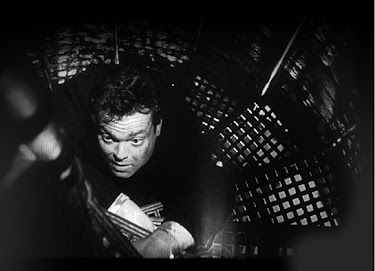


_poster.jpg)


