Directed by: Carol Reed
Written by: Walter Ebert (story), Harry Kurnitz (screenplay), Eric Linklater (screenplay) (uncredited)
Starring: James Mason, Claire Bloom, Hildegard Knef, Geoffrey Toone, Aribert Wäscher, Ernst Schröder, Karl John
WARNING: Plot and/or ending details may follow!!! [Paragraph 3 only]
Following the release of his masterpiece The Third Man (1949), a refreshingly-offbeat amalgam of British noir and Ealing-style whimsy, director Carol Reed was heralded as one of the era's most promising filmmakers. Critical admirers anxiously awaited his follow-up effort, which was four years coming. Today, the consensus appears to regard The Man Between (1953) as little but a pale imitation of The Third Man. Certainly, the two films share similar scenarios, both involving a foreigner's espionage-tinged visit to a war-torn city (Vienna and Berlin, respectively) that has been divided by opposing powers. However, despite lacking Graham Greene's wry sense of humour, and particularly the boyish charisma of Orson Welles, Reed's follow-up picture is nonetheless an excellent drama, blending romance and tragedy with the director's usual flair for generating atmosphere and international intrigue. The fine chemistry between stars James Mason and Claire Bloom finds a life of its own amid the rubble-strewn ruins of a city still at war with itself.
 Young British woman Susanne Mallison (Claire Bloom, whom Chaplin had discovered the previous year for Limelight (1952)) arrives in Berlin to visit her brother (Geoffrey Toone), who has married German-born Bettina (Hildegard Knef). Through her sister-in-law, Susanne is introduced to the enigmatic Ivo Kern (James Mason), a professional kidnapper with ambiguous allegiances towards both the Eastern and Western powers. Screenwriter Harry Kurnitz had a talent for illustrating characters with hidden motives and concealed secrets (see Witness for the Prosecution (1957), The Web (1947) or either of his Thin Man features), and his screenplay spends its first half ominously exploring the intentions of Bettina, whose association with Ivo implicitly suggests a family betrayal. Interestingly, the character is effectively abandoned in the film's second half, but to the film's advantage, as Susanne and Ivo are relentlessly hunted in the Eastern Bloc following a botched kidnapping. Here, Reed narrows his dramatic focus, but the doomed romance between Bloom's young idealist and Mason's war-weary criminal remains appropriately understated, inspiring empathy without stooping to melodrama.
 Despite the absence of Robert Krasker, The Man Between is a beautifully shot film, with director-of-photography Desmond Dickinson capturing, not only the atmosphere, but the foreboding personality of the crumbling German capital. John Addison's musical score is haunting and graceful, certainly a far cry from Anton Karas' zither, but nonetheless effective in its own right. One thing I've noticed about every Carol Reed film I've seen (and the tally currently sits at seven) is that all the performances are perfect – not only the main and supporting stars, but everybody down to the briefest of speaking roles. James Mason sports a convincing German accent, and Claire Bloom is simply adorable in her naive innocence, with a smile that will melt your heart. A particularly important character is young Horst (Dieter Krause), whose love Ivo instinctively rejects, for such a criminal can never allow himself to form attachments to those he must inevitably abandon. Ultimately, and tragically, it is Horst's devotion that results in Ivo's death, the final proof that love and death are never far apart.
8/10
Currently my #7 film of 1953:
1) From Here To Eternity (Fred Zinnemann)
2) Stalag 17 (Billy Wilder)
3) I Confess (Alfred Hitchcock) *
4) The Titfield Thunderbolt (Charles Crichton)
5) Le salaire de la peur {The Wages of Fear} (Henri-Georges Clouzot)
6) Roman Holiday (William Wyler)
7) The Man Between (Carol Reed) *
8) The Band Wagon (Vincente Minnelli)
9) Pickup on South Street (Samuel Fuller) *
10) The War Of The Worlds (Byron Haskin)
2) Stalag 17 (Billy Wilder)
3) I Confess (Alfred Hitchcock) *
4) The Titfield Thunderbolt (Charles Crichton)
5) Le salaire de la peur {The Wages of Fear} (Henri-Georges Clouzot)
6) Roman Holiday (William Wyler)
7) The Man Between (Carol Reed) *
8) The Band Wagon (Vincente Minnelli)
9) Pickup on South Street (Samuel Fuller) *
10) The War Of The Worlds (Byron Haskin)

 Richard Conte was one of the most interesting leading men of his era. His big-shot crime boss in
  This slackening of tone is seen most tellingly in the film's dramatic climax, a confrontation between Garcos and Figlia. The sequence doesn't work because it's conflicted between two opposing moral viewpoints. In one sense, Dassin appears to advocate Garcos' vigilante action in subjecting Figlia to a physical beating, since he successfully reclaims his stolen payments and achieves some degree of mental closure regarding his father's crippling. However, at this moment, as Garcos collapses onto the bench in exhaustion, policemen enter the diner and arrest Figlia for his crimes – but not before one officer sternly wags his finger at Garcos for taking the law into his own hands. To have an excellent film intruded upon by such an awkward, juvenile moral lesson is bad enough, but the film could have gotten across the same message in a more powerful manner. As the police stormed into the diner, my blood had suddenly run cold with the chilling thought: what if Figlia is dead? Out of pure bloody-minded pride, a good man would have been condemned for life, the ultimate testament that vigilantism is not the answer.
 Foster's film opens in a pub, as the drunken patrons are shuffled into the street at closing time. There sits Bill Saunders (Lancaster) at the bar, lonely and brooding, so utterly distanced from society that he refuses to follow his fellow drinkers out the door. When the publican becomes forceful, Bill suddenly jerks into action, striking out with a heavy fist that leaves his aggressor dead on the floor. "Chum, you've been and gone and done it," remarks one stunned onlooker (Newton) gravely; "he's dead. You've killed him." This is what film noir is all about: that fundamental moment when there's no turning back. After a thrilling chase through the London streets (though I notice that the characters still drive left-handed vehicles), Bill finds refuge in the apartment of Jane Wharton (Fontaine), whose unexpected compassion leads him to seek a relationship with her. At this point, the film quickly and inexplicably forgets that Bill is a fugitive wanted for murder. Or, perhaps more accurately, it waits for us to forget.
 Only after Bill Saunders has reestablished his place in society does his past rear its ugly head, in the form of Robert Newton's grotesquely cavalier black-market fraudster. This isn't the first time in Lancaster's career that his character's past had inescapably returned to haunt him: in Siodmak's
  Underpinning The Naked City is producer Mark Hellinger's narration, which serves as both a prop and a vice. Absolutely essential is the final sign-off, which remarks "there are eight million stories in the Naked City. This has been one of them." Coming only moments after a murderer falls to his death from the Williamsburg Bridge, this narration assures us, as critic Luc Sante writes in his Criterion Collection essay, "that what we briefly experienced as a cosmic struggle up above the earth was really just another statistic." In a city of eight million people, such high-drama attains only passing significance: workers file past the apartment building where a young model was brutally murdered; children play jump-rope outside the office window of a detective embroiled in a homicide case; a street-sweeper cleans up yesterday's discarded newspaper, its headline "DEXTER MURDER SOLVED!" having since given way to more pertinent news. However, Hellinger's narration, which chimes in at regular intervals, can also be intrusive, and I disliked the cheerful, cloying manner in which it interacted with the characters, as in a contemporary newsreel.
 Despite revolving around a police procedural that has many of the classic dramatic ingredients – most memorably a suave jewel thief and pathological liar (Howard Duff) – it is only when detectives Muldoon (Barry Fitzgerald) and Halloran (Don Taylor) take to the streets that The Naked City really springs to life. Dassin filmed most of his exteriors out in the gritty urban walkways, often without the knowledge of bystanders, and the resultant atmosphere is fundamental to his storytelling style. New York simply seems so real, bustling with the minor details of activity – children playing in the streets, salesmen pushing their carts – that are impossible to duplicate on a studio backlot. However, rather than serving merely as a documentary portraiture of city life, as in Vertov's The Man with a Movie Camera (1929), the film's authentic environment instead functions to solidify the immediacy of the underlying drama. While Dassin's ability to juggle these disparate elements at times appears strained, he would perfect his method for what is, for my money, the director's masterpiece:
  Despite a slow first half, in which Fields' typical espionage duties are introduced via a lot of silent waiting, The Thief picks up substantially once the American authorities catch wind of his crimes. Rouse cultivates some truly thumping suspense sequences, including a magnificent stairway pursuit up the then-tallest building in the world, the Empire State. This breathless flight from the 88th floor observatory to the 102nd floor, and beyond, serves as a convenient allegory for Fields' Communist involvement. As an FBI agent rushes in pursuit, Milland's character tries repeatedly to escape through service doors on each floor, only to find them locked each time. Throughout the film, despite wishing to abandon his treasonous practices, Fields consistently finds his path to freedom blocked, his only option to continue what he's been doing, further implicating himself with each staircase he ascends. When inevitably cornered high above New York City, ironically defenseless at the pinnacle of human achievement, Fields desperately lashes out at his aggressor, and does the unthinkable.
 In spite of my reservations that only a low-budget film could get away with such an anachronistic style, The Thief does, in fact, boast excellent production values. Sam Leavitt's cinematography is graceful but with an edge of documentary-realism. I particularly enjoyed the lurid confusion of Fields' nervous breakdown (perhaps a nod to Wilder's The Lost Weekend (1945)), with an increasingly-claustrophobic Milland filmed from above like an insignificant pawn, as specks of blood appear to permeate the walls. Despite his Oscar, Ray Milland is one of his generation's most underrated leading men, and he handles an exceedingly difficult role with poise and empathy: just watch Fields' pang of guilt every time he glances at the Capitol Dome, a symbol of American nationalism. Despite its sympathetic portrayal of a Commie spy, the film is nevertheless patriotic, as it must have been at this time. Indeed, Fields' ultimate decision to confess everything to the FBI comes not with the realisation that he is a bad person, but the realisation that he is a bad American.
 The Killers opens with a superbly-thrilling prologue that sees two hired thugs (William Conrad and B-noir stalwart Charles McGraw) harass the patrons at a small-town diner on their way to assassinate boxer- turned-gangster Swede Andersen. The characters' quickfire exchange of dialogue resembles something that Quentin Tarantino or the Coen brothers would have written decades later, only better, because screenwriter Anthony Veiller (with Richard Brooks and John Huston) reproduces the conversation from Hemingway's short story almost verbatim. After Andersen is unresistingly gunned down in his bed, the screenplay then expands upon the foundations laid down by the source material, using flashbacks to fill in the empty spaces at which Hemingway had only hinted. Veiller, whose work before WWII was dominated by romantic dramas, comedies and light mysteries like The Ex-Mrs. Bradford (1936), appears to have been hardened by his work on Frank Capra's Why We Fight propaganda series, and the dark, cynical post-War tone he brings to Swede's tragic story is an ideal representation of the noir spirit.
  Burt Lancaster shows promise in his screen debut, though the film's narrative structure does keep the audience distant from his character, an issue that Welles somehow avoided in Citizen Kane. As the resident femme fatale, Ava Gardner never quite inspires the collective hatred garnered by Barbara Stanwyck in Double Indemnity (1944) or Jane Greer in Out of the Past (1947), but perhaps that speaks to her charms – that, despite her betrayal, we're still unwilling to treat her with due contempt. Good-guy Edmond O'Brien cheerfully and voyeuristically experiences the wretched life of a gangster through the intermediary flashback device – he ends the film with a cocky grin, like an audience-member emerging from a screening of the latest gangster thriller. Throughout this review, I've been making frequent allusions to Citizen Kane, but there's a very important difference between the two main characters: Charles Foster Kane had all the money in the world and got nothing out of it. Swede Andersen wasn't even that lucky; he didn't even get the money.
  I don't want to describe this film as exploitation. It certainly is exploitative to a huge degree – Fuller, for example, wrings every ounce of empathy from the poor crippled kids – but somehow there's a sense of sincerity in how he tells the story, as though he really does believe in the possibility of redemption. Tough, independent-minded prostitute Kelly (Towers) arrives in a new town, sleeps with the police captain (Anthony Eisley), and then decides to leave her shameful past behind forever, somehow securing a job at the local children's hospital. Captain Griff is immediately suspicious of Kelly's motivations, hypocritically believing that she'll only pollute his home town, but wealthy local benefactor J.L. Grant (Michael Dante) falls in love with her. When it came to women, Fuller appears to have admired the lowly kind: Constance Towers in Shock Corridor (1963) was a stripper, Towers in The Naked Kiss was a prostitute, and Jean Peters in
  Especially in its final act, The Naked Kiss has strong elements of film noir – substituting the usual male protagonist for a woman, of course – but there's also high degrees of melodrama, exploitation, and pulpy, B-movie schlock. Fuller's ultimate message appears to be double- edged. A prominent noir motif concerns the sheer hopelessness of redemption: however hard one tries to evade their past, a man's former misdeeds will always return to haunt them. This fate does, indeed, confront Fuller's heroine, but he leaves a light at the end of the tunnel, arguably dampening the full brunt of the film's ending. Perhaps the more potently-noirish message to be gleaned from The Naked Kiss is that society is rotten: not just the mistreated prostitutes and tyrannical pimps, but the hypocritical police captain, the prejudiced townsfolk, the philanthropist with an ulterior motive in funding a children's hospital. Towers' prostitute crosses to the "respectable" side of society's fence, but finds that corruption has already pervaded to its highest levels.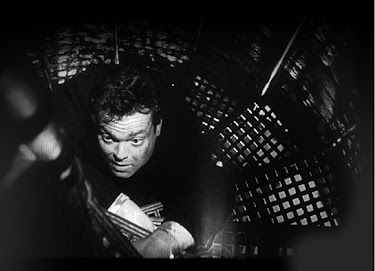


_poster.jpg)


