Directed by: Harold Daniels
Written by: Richard H. Landau (story), Daniel Mainwaring (story), Steve Fisher (writer), George Bricker (writer)
Starring: Charles McGraw, Joan Dixon, Lowell Gilmore, Louis Jean Heydt, Milburn Stone, Peter Brocco, Barry Brooks
 WARNING: Plot and/or ending details may follow!!!
 Roadblock (1951) has plenty of the classic film noir ingredients, but it also recalls all those landmarks from which it borrowed them. An honest insurance detective is corrupted into defrauding his own employer – that's straight from Double Indemnity (1944). A swift, suffocating city-wide dragnet embraces the fleeing anti-hero, stifling his final chance of escape – that recalls High Sierra (1941). Even leading man Charles McGraw, typically confined to supporting roles, might credibly be described as a "poor man's Kirk Douglas." In fact, with his chiselled facial features and a gravelly voice, I occasionally found myself picturing Douglas in the role. I also saw Gene Tierney in Joan Dixon's place, but that's just me and my wishful imagination. All things considered, the two main performers do quite well in a B-movie that offers no surprises. Content to follow the already-established film noir mould – to drive the riverbed without breaching its banks, so to speak – director Harold Daniels has produced an entertaining, workman-like thriller. But why rewatch it, especially when you can instead enjoy its superior predecessors?
The film, intended as the lower half of a double-bill, jumps straight into action. A fugitive bank robber (Peter Brocco) becomes witness to a homicide, the killer taking him hostage and threatening to dispose of him. After offering his stolen loot in exchange for his life, the film pulls its first – and probably only – unexpected twist. The "killer" is, in fact, L.A. insurance detective Joe Peters (Charles McGraw), who engineered the mock murder of his partner (Louis Jean Heydt) to discover the whereabouts of the missing bank money. Peters is fiercely honest, having resigned himself to an unglamorous life on a modest detective's income, but this episode foreshadows his character's transformation into a liar, murderer and fugitive. Why do good men turn bad? In Roadblock – as in all noir – the blame is irrevocably placed on a woman. Unashamed gold-digger Diane (Joan Dixon) taunts Peters with her icy beauty, disdainfully implying that he could never afford somebody like her on such a meagre salary. If you're going to turn to crime, I guess sex is as good a reason as any.
Roadblock was directed by Harold Daniels, who doesn't appear to have much else of note to his name, but the cinematography was by Nicholas Musuraca, whose exquisite noirish work is also on display in Stranger on the Third Floor (1940), Cat People (1942) and Out of the Past (1947). What I love most about film noir is how the photography so often suggests more than would otherwise be understood. For example, despite beginning the film as a questionable, if seductive, chiseller, Joan Dixon's character later takes a turn towards the uninteresting, rejecting her former prestigious life-style in favour of love and marriage (making Peters' fatal transformation ironically unnecessary). Having now settled into her new role as a slighted romantic lover, and apparently deserving of our sympathy, Diane witnesses her husband gunned down by police, and resignedly departs the scene. It's not spoken, but Musuraca's camera doesn't forget who's to blame for this tragedy: he frames her strutting purposely - almost dismissively - away from the devastation her hand has caused, like a gunman turning his back on a massacre.
6/10
Currently my #9 film of 1951:
1) Strangers On A Train (Alfred Hitchcock) *
2) The African Queen (John Huston)
3) The Man in the White Suit (Alexander Mackendrick)
4) The Day The Earth Stood Still (Robert Wise)
5) The Lavender Hill Mob (Charles Crichton) *
6) The Thing from Another World (Christian Nyby, Howard Hawks)
7) An American in Paris (Vincente Minnelli)
8) Royal Wedding (Stanley Donen)
9) Roadblock (Harold Daniels) *
10) Behave Yourself! (George Beck)
2) The African Queen (John Huston)
3) The Man in the White Suit (Alexander Mackendrick)
4) The Day The Earth Stood Still (Robert Wise)
5) The Lavender Hill Mob (Charles Crichton) *
6) The Thing from Another World (Christian Nyby, Howard Hawks)
7) An American in Paris (Vincente Minnelli)
8) Royal Wedding (Stanley Donen)
9) Roadblock (Harold Daniels) *
10) Behave Yourself! (George Beck)

 Robert Wise was certainly one of Hollywood's most versatile directors, having released excellent films from almost every major genre – science-fiction, horror, drama, musical, war. The Set-Up was produced on a low budget by RKO, with a story that unfolds in real-time (predating Zinnemann's High Noon (1952), which famously used this approach). Despite a taut 72-minute running-time, the film packs a considerable emotional punch, as the sympathetic Stoker places his dignity on the line, sticks to his guns, and winds up being punished for his nobility. Robert Ryan gives a characteristically intense leading performance, eliciting empathy, but also exhibiting a quiet, understated dignity. When his fellow boxers emerge from their bouts, either ecstatic in victory or discouraged in defeat, there's a heartbreaking sadness in Stoker's eyes, as though every time he must front the challenge of his own aging body. Among the compelling supporting performers is David Clarke as a self-deluding washed-up boxer, and Alan Baxter (looking a bit like Frank Sinatra, I thought) as a cold-eyed gangster who wears sharp suits but, unlike Stoker, hasn't any class or principles.
 The Set-Up, in exposing the unglamorous side of the boxing profession, certainly served as inspiration for Martin Scorsese's Raging Bull (1980), and probably also influenced Kubrick in his early noir thriller Killer's Kiss (1955). The boxing match between Stoker and Tiger Nelson (Hal Fieberling) is an gritty four-round exchange of bludgeoning blows, and every connecting swipe sent a shudder of discomfort through my body. Even more fascinating, however, is how Wise focuses much attention on the match spectators, perhaps the most depraved selection of sadistic souls you're likely to find at any sporting event: an excited house-wife calls for a prolonging of the boxers' suffering; a blind man cries "go for his eyes," his cruel mind filling in the bloody details; the ever-composed Little Boy (Baxter) watches through shrewd, calculating eyes. The atmosphere of the boxing stadium is oppressive and stifling, the meeting-place of society's most decadent citizens. Ironically, it is only when he is defeated by this environment that Stoker can ever escape its clutches. He strikes the bottom of the barrel, his honour intact only in his eyes.


 I hadn't realised that Lake was so incredibly short. Having only seen her in three films opposite Alan Ladd, whose comparatively small stature made him an ideal screen partner, it was surprising to see the 6' 3" Joel McCrea positively tower above her. This must have caused headaches for the cinematographer who was valiantly trying to frame both stars into every shot. Nevertheless, Lake doesn't let her petite size get in the way of a solid performance, and, indeed, her character is surprisingly malevolent. Borrowing a leaf from the femme fatales of the film noir style, which was in full swing by the late 1940s, Lake's Connie Dickason is a feisty customer, a pugnacious ranch-woman whose determination to upset the balance of power in her small western town turns her as nasty as the male oppressors whom she so despises. She deliberately breaks the law to achieve her self-righteous ends, and attempts to rope men into her scheme through the promise of sex. Yet Connie remains a moderately sympathetic character.
 Pat O'Brien is typically known for playing priests, the level-headed foil for James Cagney's explosive gangster. In other words, he's usually the least-interesting character in the film. Crack-Up (1946) marks a welcome change-of-pace for the actor. No longer is O'Brien the calm, collected cleric, but a confused art critic at the end of his rope, doubting his own sanity as he battles murder and conspiracy. He perhaps isn't perfect for the role – the film's lurid moments would have been even more lurid had the lead actor been able to act more deranged – but O'Brien receives good supporting back-up from Claire Trevor, Herbert Marshall and Ray Collins. Director Irving Reis (best known for his "Falcon" series, though he also co-directed the annoyingly manipulative Hitler's Children (1943) with Edward Dmytryk) does well to develop the film's mood, not afraid to dabble in a bit of surrealism to help translate the mental confusion and degradation of his main protagonist. There's also a little Freudian psychoanalysis in there, as was popular at the time, but the distraction it causes to the story is only an afterthought.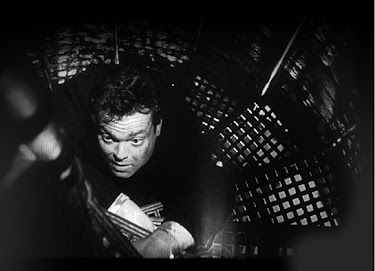


_poster.jpg)


