Directed by: Jules Dassin
Written by: Malvin Wald (story & screenplay), Albert Maltz (screenplay)
Starring: Barry Fitzgerald, Howard Duff, Dorothy Hart, Don Taylor, Frank Conroy, Ted de Corsia, House Jameson
Italian neorealism, which reached its zenith with Vittorio De Sica's Bicycle Thieves (1948), was distinguished from other cinematic styles through its use of non-professional actors, loosely-plotted and realistic story lines, and unstylised on-location photography. Jules Dassin's The Naked City (1948) is a fair Hollywood attempt at blending the styles of neorealism and film noir, both of which were at the time only beginning to receive due recognition. At first glance, the two movements appear to sit at opposite ends of the stylistic and ideological spectrum: film noir typically concerns the fate of ordinary men trapped in exceptional circumstances, whereas Italian neorealism presents its characters' struggles as decidedly unremarkable, representative of the societal norm. Where these two particular films converge is in emphasising the invisibility of drama in real-life. De Sica's bicycle-seeking protagonists, dejected and beaten, disappear amid the crowds of workers. In his desperate flight from the authorities, Dassin's Willie Garzah (Ted de Corsia) carves a disruptive path through the crowds of New Yorkers, but the city schedule is interrupted only briefly.
 Underpinning The Naked City is producer Mark Hellinger's narration, which serves as both a prop and a vice. Absolutely essential is the final sign-off, which remarks "there are eight million stories in the Naked City. This has been one of them." Coming only moments after a murderer falls to his death from the Williamsburg Bridge, this narration assures us, as critic Luc Sante writes in his Criterion Collection essay, "that what we briefly experienced as a cosmic struggle up above the earth was really just another statistic." In a city of eight million people, such high-drama attains only passing significance: workers file past the apartment building where a young model was brutally murdered; children play jump-rope outside the office window of a detective embroiled in a homicide case; a street-sweeper cleans up yesterday's discarded newspaper, its headline "DEXTER MURDER SOLVED!" having since given way to more pertinent news. However, Hellinger's narration, which chimes in at regular intervals, can also be intrusive, and I disliked the cheerful, cloying manner in which it interacted with the characters, as in a contemporary newsreel.
 Despite revolving around a police procedural that has many of the classic dramatic ingredients – most memorably a suave jewel thief and pathological liar (Howard Duff) – it is only when detectives Muldoon (Barry Fitzgerald) and Halloran (Don Taylor) take to the streets that The Naked City really springs to life. Dassin filmed most of his exteriors out in the gritty urban walkways, often without the knowledge of bystanders, and the resultant atmosphere is fundamental to his storytelling style. New York simply seems so real, bustling with the minor details of activity – children playing in the streets, salesmen pushing their carts – that are impossible to duplicate on a studio backlot. However, rather than serving merely as a documentary portraiture of city life, as in Vertov's The Man with a Movie Camera (1929), the film's authentic environment instead functions to solidify the immediacy of the underlying drama. While Dassin's ability to juggle these disparate elements at times appears strained, he would perfect his method for what is, for my money, the director's masterpiece: Night and the City (1950).
7.5/10
Currently my #6 film of 1948:
1) The Treasure of the Sierra Madre (John Huston)
2) Ladri di biciclette {The Bicycle Thief} (Vittorio De Sica)
3) Rope (Alfred Hitchcock)
4) Oliver Twist (David Lean)
5) The Red Shoes (Michael Powell, Emeric Pressburger)
6) The Naked City (Jules Dassin) *
7) Macbeth (Orson Welles)
8) Key Largo (John Huston) *
9) Letter from an Unknown Woman (Max Ophüls)
10) Secret Beyond the Door… (Fritz Lang) *

 Despite a slow first half, in which Fields' typical espionage duties are introduced via a lot of silent waiting, The Thief picks up substantially once the American authorities catch wind of his crimes. Rouse cultivates some truly thumping suspense sequences, including a magnificent stairway pursuit up the then-tallest building in the world, the Empire State. This breathless flight from the 88th floor observatory to the 102nd floor, and beyond, serves as a convenient allegory for Fields' Communist involvement. As an FBI agent rushes in pursuit, Milland's character tries repeatedly to escape through service doors on each floor, only to find them locked each time. Throughout the film, despite wishing to abandon his treasonous practices, Fields consistently finds his path to freedom blocked, his only option to continue what he's been doing, further implicating himself with each staircase he ascends. When inevitably cornered high above New York City, ironically defenseless at the pinnacle of human achievement, Fields desperately lashes out at his aggressor, and does the unthinkable.
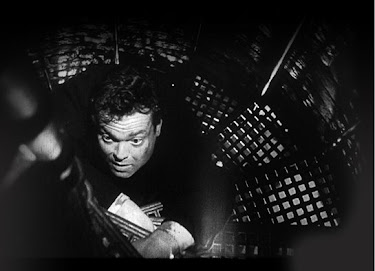
 In spite of my reservations that only a low-budget film could get away with such an anachronistic style, The Thief does, in fact, boast excellent production values. Sam Leavitt's cinematography is graceful but with an edge of documentary-realism. I particularly enjoyed the lurid confusion of Fields' nervous breakdown (perhaps a nod to Wilder's The Lost Weekend (1945)), with an increasingly-claustrophobic Milland filmed from above like an insignificant pawn, as specks of blood appear to permeate the walls. Despite his Oscar, Ray Milland is one of his generation's most underrated leading men, and he handles an exceedingly difficult role with poise and empathy: just watch Fields' pang of guilt every time he glances at the Capitol Dome, a symbol of American nationalism. Despite its sympathetic portrayal of a Commie spy, the film is nevertheless patriotic, as it must have been at this time. Indeed, Fields' ultimate decision to confess everything to the FBI comes not with the realisation that he is a bad person, but the realisation that he is a bad American.
 The Killers opens with a superbly-thrilling prologue that sees two hired thugs (William Conrad and B-noir stalwart Charles McGraw) harass the patrons at a small-town diner on their way to assassinate boxer- turned-gangster Swede Andersen. The characters' quickfire exchange of dialogue resembles something that Quentin Tarantino or the Coen brothers would have written decades later, only better, because screenwriter Anthony Veiller (with Richard Brooks and John Huston) reproduces the conversation from Hemingway's short story almost verbatim. After Andersen is unresistingly gunned down in his bed, the screenplay then expands upon the foundations laid down by the source material, using flashbacks to fill in the empty spaces at which Hemingway had only hinted. Veiller, whose work before WWII was dominated by romantic dramas, comedies and light mysteries like The Ex-Mrs. Bradford (1936), appears to have been hardened by his work on Frank Capra's Why We Fight propaganda series, and the dark, cynical post-War tone he brings to Swede's tragic story is an ideal representation of the noir spirit.
 Burt Lancaster shows promise in his screen debut, though the film's narrative structure does keep the audience distant from his character, an issue that Welles somehow avoided in Citizen Kane. As the resident femme fatale, Ava Gardner never quite inspires the collective hatred garnered by Barbara Stanwyck in Double Indemnity (1944) or Jane Greer in Out of the Past (1947), but perhaps that speaks to her charms – that, despite her betrayal, we're still unwilling to treat her with due contempt. Good-guy Edmond O'Brien cheerfully and voyeuristically experiences the wretched life of a gangster through the intermediary flashback device – he ends the film with a cocky grin, like an audience-member emerging from a screening of the latest gangster thriller. Throughout this review, I've been making frequent allusions to Citizen Kane, but there's a very important difference between the two main characters: Charles Foster Kane had all the money in the world and got nothing out of it. Swede Andersen wasn't even that lucky; he didn't even get the money.
 I don't want to describe this film as exploitation. It certainly is exploitative to a huge degree – Fuller, for example, wrings every ounce of empathy from the poor crippled kids – but somehow there's a sense of sincerity in how he tells the story, as though he really does believe in the possibility of redemption. Tough, independent-minded prostitute Kelly (Towers) arrives in a new town, sleeps with the police captain (Anthony Eisley), and then decides to leave her shameful past behind forever, somehow securing a job at the local children's hospital. Captain Griff is immediately suspicious of Kelly's motivations, hypocritically believing that she'll only pollute his home town, but wealthy local benefactor J.L. Grant (Michael Dante) falls in love with her. When it came to women, Fuller appears to have admired the lowly kind: Constance Towers in Shock Corridor (1963) was a stripper, Towers in The Naked Kiss was a prostitute, and Jean Peters in
 Especially in its final act, The Naked Kiss has strong elements of film noir – substituting the usual male protagonist for a woman, of course – but there's also high degrees of melodrama, exploitation, and pulpy, B-movie schlock. Fuller's ultimate message appears to be double- edged. A prominent noir motif concerns the sheer hopelessness of redemption: however hard one tries to evade their past, a man's former misdeeds will always return to haunt them. This fate does, indeed, confront Fuller's heroine, but he leaves a light at the end of the tunnel, arguably dampening the full brunt of the film's ending. Perhaps the more potently-noirish message to be gleaned from The Naked Kiss is that society is rotten: not just the mistreated prostitutes and tyrannical pimps, but the hypocritical police captain, the prejudiced townsfolk, the philanthropist with an ulterior motive in funding a children's hospital. Towers' prostitute crosses to the "respectable" side of society's fence, but finds that corruption has already pervaded to its highest levels.
 Though one would stop short of calling this a film noir, there are certainly traces of the necessary elements. Most prominent is the theme of hidden family secrets, of a shameful past coming back to haunt wrongdoers, as in
 John Raden (Albert Dekker) is the film's hapless protagonist, an honest guy who unwillingly stumbles upon his family's dirty secret. Via a succession of ill-fated coincidences, implying the forces of Fate that would later pervade the film noir movement, John finds himself on trial for murder, thrust protestingly into an ad hoc mob trial that recalls Peter Lorre's judgement in M (1931). Dekker is excellent in the dual-roles of John and Paul Raden, with the "bad" half always distinguishable, not just by his grizzled beard and raggedy clothing, but by the way he carries himself: slouched shoulders, arms held awkwardly, innocent and perplexed eyes upturned at the eccentricities of this unfamiliar society. Susan Hayward plays Millie, a minor femme fatale. She's an angel when you first see her, but the way she knowingly toys with Paul's naivete is quite repulsive, and her nastiness during the courtroom trial is similarly brutal. Notably, director Stuart Heisler would progress on to full-blown noir the following year with his Hammett adaptation
 Bob Regan (O'Brien) is a two-bit lawyer with the bluster of a high-price attorney. In his first scene, Regan sidles through a busy reception office, offends a secretary (Raines) with some surprisingly-forward sexual banter, before busting in on millionaire businessman Andrew Colby (Price) and demanding the sum of exactly $68.72. Impressed with Regan's passion for the job, Colby hires him for a high-paying, two-week stint as a personal bodyguard. However, when Regan guns down Leopold Kroner (Fritz Leiber), a former associate of Colby's who was recently released from prison, he finds himself in hot water with detective Damico (Bendix), who scents murder. Desperate to clear his name, Regan begins to investigate Colby's shady dealings, reluctantly exploiting the affections of secretary Noel Faraday for information. Meanwhile, Vincent Price's articulate, calculating Colby plots the coup de grâce of his high-stakes crime spree, culminating in a murder frame-up that initially seems so airtight that I couldn't imagine any way for our hero to get out of it.
 Though it doesn't necessarily offer any new material for the film noir lexicon, nor does The Web feel contrived. The romance between O'Brien and Raines could easily have been squandered with melodrama, but the film always keeps their relationship edgy. Noel's affections, for one, are clearly split between Regan and Colby, whose association with her visibly extends beyond the professional realm ("I recognise him when I see him"). Regan himself, while essentially good-hearted, has a clumsy crudeness about him where women are concerned, in contrast with Colby, who always knows what to say and how to say it. There's something subtly fascinating about Price's 1940s performances; it has to do with how he speaks. When his character is telling an untruth, he does so in a manner that, to us, reeks of deception, and yet we can perfectly understand why the film's characters – say, a policeman – swallow the lie whole. He toes a fine line, and still manages to suspend the audience's disbelief. Maybe that's why Price got away with starring in so many bad movies.
 McEvoy's film unfolds in an unglamorous docu-drama style. Reed Hadley's narration sounds as though it was plucked straight from a newsreel, reciting facts as if reading off the official police transcript. This technique does feel a little cheap at times, but fortunately the narration is largely restricted to the film's bookends, as well as providing some explanatory filler during breaks in the plot. The "killer" stalking New York, in this story, is not a rug importer from Mexico, but beautiful diamond smuggler Sheila Bennet (Evelyn Keyes), who has just arrived from Cuba. Within days, Sheila has two parties independently pursuing her: a treasury agent (Barry Kelley) looking to arrest her for smuggling crimes, and a team of doctors (led by William Bishop) who have identified her as the source of the smallpox outbreak. As in 'Panic in the Streets,' an otherwise routine manhunt is given a heightened sense of urgency, particularly when those in pursuit initially have no idea as to the identity or appearance of their suspect.
 The Killer That Stalked New York, for the most part, manages to sidestep its low production budget. Aside from a select few lines of dialogue ("we have to stop it!" exclaims Dr. Wood at one point, as though coming to a difficult decision), the filmmakers and cast members allow the story to unfold in a realistic, engrossing fashion. Indeed, in this regard, the low budget quite possibly aids the film's intentions, necessitating a documentary style that adds to the immediacy of the outbreak scenario. Evelyn Keyes is excellent in the leading role, showing obstinate resilience in the face of unimaginable torment; by the film's end, she appears so brutally incapacitated by her illness that it's almost painful to look at her face. Aside from the virus, Charles Korvin is the main villain of the piece, as Sheila's greedy and adulterous husband who, rest assured, gets everything that's coming to him. And if all nurses looked like Dorothy Malone, perhaps catching smallpox wouldn't seem like such a bad break, after all.